Normally, I dedicate a good amount of travel-related posts to describe the gastronomical experience that each place I visit has to offer. I regret to say that Bhutan will not receive that same effort, particularly so after my first exposure to the local cuisine in Thimphu, Bhutan’s capital city for the last fifty years or so. I had largely been fed Indian food in the accommodation in Paro and finally requested to taste some local, more authentic dishes. So, in addition to dhal and chicken do pyaza, I was also served three dishes typical to Bhutanese cuisine--- chilies with cheese (emadatse), potatoes with cheese (kewadatse), and red rice. Suffice it to say that while they were pleasant to the palate, I am highly doubtful I’ll ever develop a craving for these again. When I requested a soft drink to accompany my dinner, I was served a Tiger beer by a young waitress, who was subsequently scolded by the older waiter for getting my order “wrong.” When I acknowledged that I’d agreed to have the beer, he, to my humor, felt the need to reconfirm twice that I would in fact opt for the beer over a soda. After all, the order surely must have been misunderstood if a South Asian woman had voluntarily opted for an alcoholic beverage!
Thimphu is the only capital city in the world with no traffic lights. Traffic police have actually come to be a tourist attraction, particularly as they robotically and theatrically direct traffic in twenty-five minute shifts. The city feels like more of a medium-sized Swiss town, but its rich art scene and abundance of cultural and religious sites add tremendously to its colorful legacy. Our first stop today was to the National Memorial Chorten, built in memory of Bhutan’s third king. Several Drukpa (people of Bhutan) start their day here in worship, circumambulating the massive stupa in the center at least three times, spinning their prayer wheels and chanting, “Om Mani Peme Hum,” which roughly translates as, ‘hail to the jewel in the lotus.’ Behind the stupa is a prayer hall, where monks perform rituals for the deceased of those who can’t afford to finance a traditional Buddhist funeral. Today, I got to witness such a ritual being done as monks chanted, while others blew on the dunchen, a long trumpet-like instrument that rests at an angle on the ground while the seated blower rests the mouthpiece on his lips to play. Upon entering the grounds, massive prayer wheels were being spun by the aged as they devoutly sat in prayer with their packed meals by their sides. They had a very long day ahead of them!
 |
| National Memorial Chorten |
 |
| Worshippers circumambulating the Chorten |
 |
| Worshippers with beads and prayer wheels in hand |
 |
| Prayer for the day |
 |
| Turning prayer wheels for another 8 hours ahead |
 |
| The National Memorial Chorten |
Bhutan is peppered with dzongs and lhakhangs, which are the main tourist attractions of the country. But, Thimphu, being the cultural center, also offers visitors a chance to visit their many painting and handicrafts schools. The most holistic is the National Institute of Zorig Chusum, which is committed to preserving and teaching students the thirteen traditional arts and crafts of Bhutan --- shing zo (woodwork), dho zo (stonework), par zo (carving), lha zo (painting), jim zo (sculpting), lig zo (casting), sga zo (wood turning), gar zo (blacksmith), troe zoe (ornament making), tsha zo (bamboo work), de zo (paper making), tshem zo (embroidery), and thag zo (weaving). Interestingly, however, most handicraft stores sell an abundance of Nepali and Tibetan goods that are brought across the borders for selling to tourists. Prices are often marked up by double, triple, and even quadruple their selling price in their countries of origin, which is a little disappointing for the eager shopper like me.
One of the most famous temples of Bhutan is in Thimphu – the Changangkha Lhakhang, whose main deity is Chenrizig, the eleven-headed, thousand-armed avatar of the Buddhist deity Avalokiteshwara, lord of the world. It’s a small but old temple, famous for its black and gold prayer wheels lodged into its white-washed walls. Couples bring their newborns here to be named, sometimes after the temple itself.
 |
| Changangkha Lhakhang |
 |
| Black and gold prayer wheels of the Lhakhang |
 |
| Takin, the national animal of Bhutan! |
 |
| Nuns at the Zilluka Nunnery 'yellow-washing' the papers of mantra to be slipped into prayer wheels |
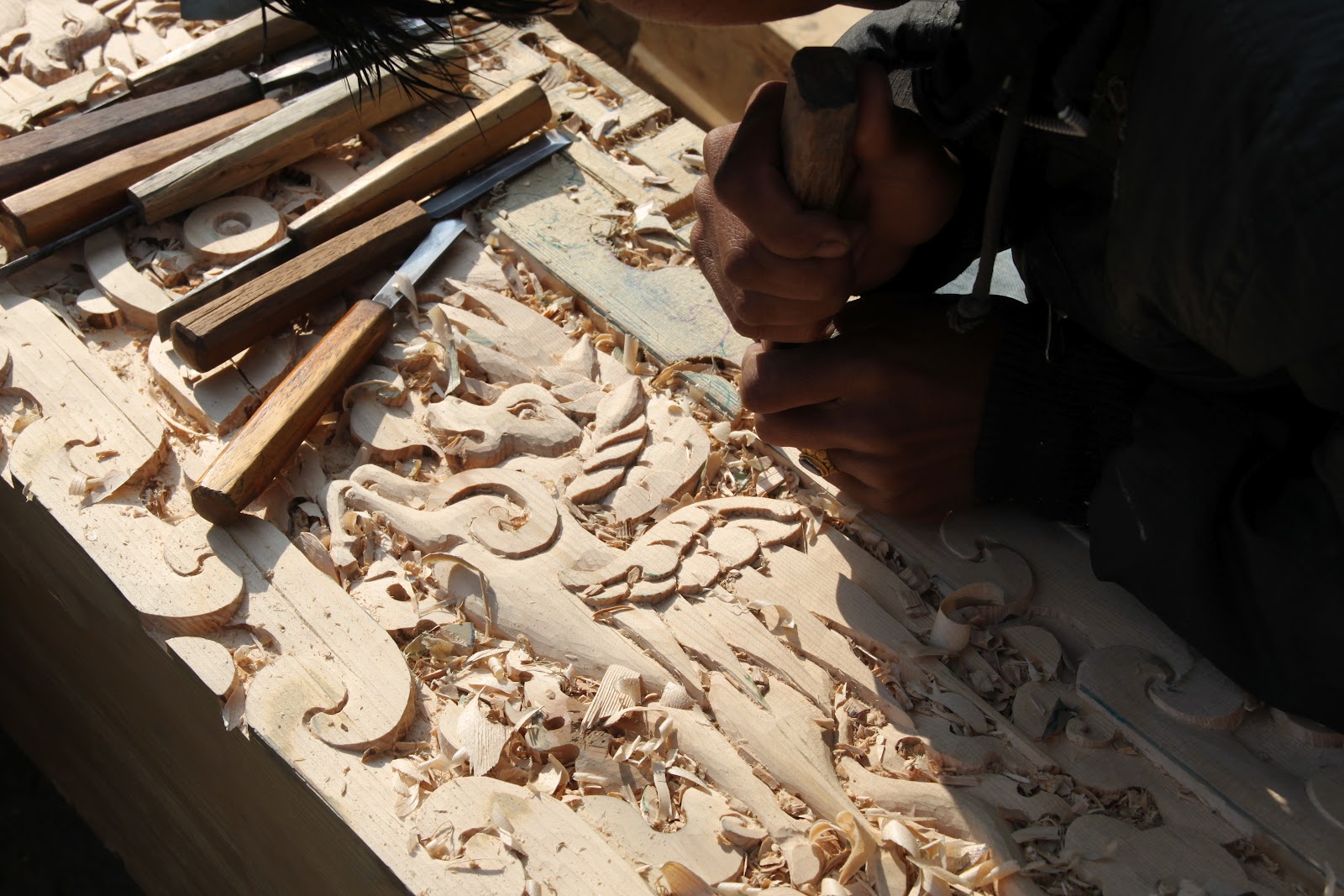
En route from Thimphu to our next stop in Wangdue, moving slightly southeast of Thimphu, we passed through the Dochula Pass, from which point the elevation drops rapidly as one moves eastward. The turning point is marked by a stunning shrine that the fourth queen had built in honor of her husband. The Druk Wangyal Khangzang Chhortens are one hundred and eight white-washed stupas with black and gold Buddhas carved within apses on each of their four faces. The view of the Himalayas is stunning from here on a clear day. After two hours’ drive from here, we reached the very windy town of Wangdue, famous for housing one of the oldest dzongs in Bhutan. When I visited, it was under renovation with hundreds of workers, including school children on winter break, carrying loads of materials to and fro while monks distributed water bottles. Here, we had the opportunity to watch some of the young craftsmen at work, carving and painting the new pillars and roof ridges that would soon ornament the renovated dzong. It was spectacular!
 |
| The Druk Wangyal Khanzang Chhortens |
 |
| White-washed chhortens against a moon backdrop |
 |
| The primary chhorten |
 |
| Black and gold Buddhas |
 |
| Entrance to Wangdue Dzong |
 |
| Massive prayer wheel by a god of direction |
 |
| Under renovation |
 |
| Craftsman at work |
 |
| Say hi! |
 |
| Original prayer wheels of the dzong |
 |
| A volunteer folds festival hangings |
 |
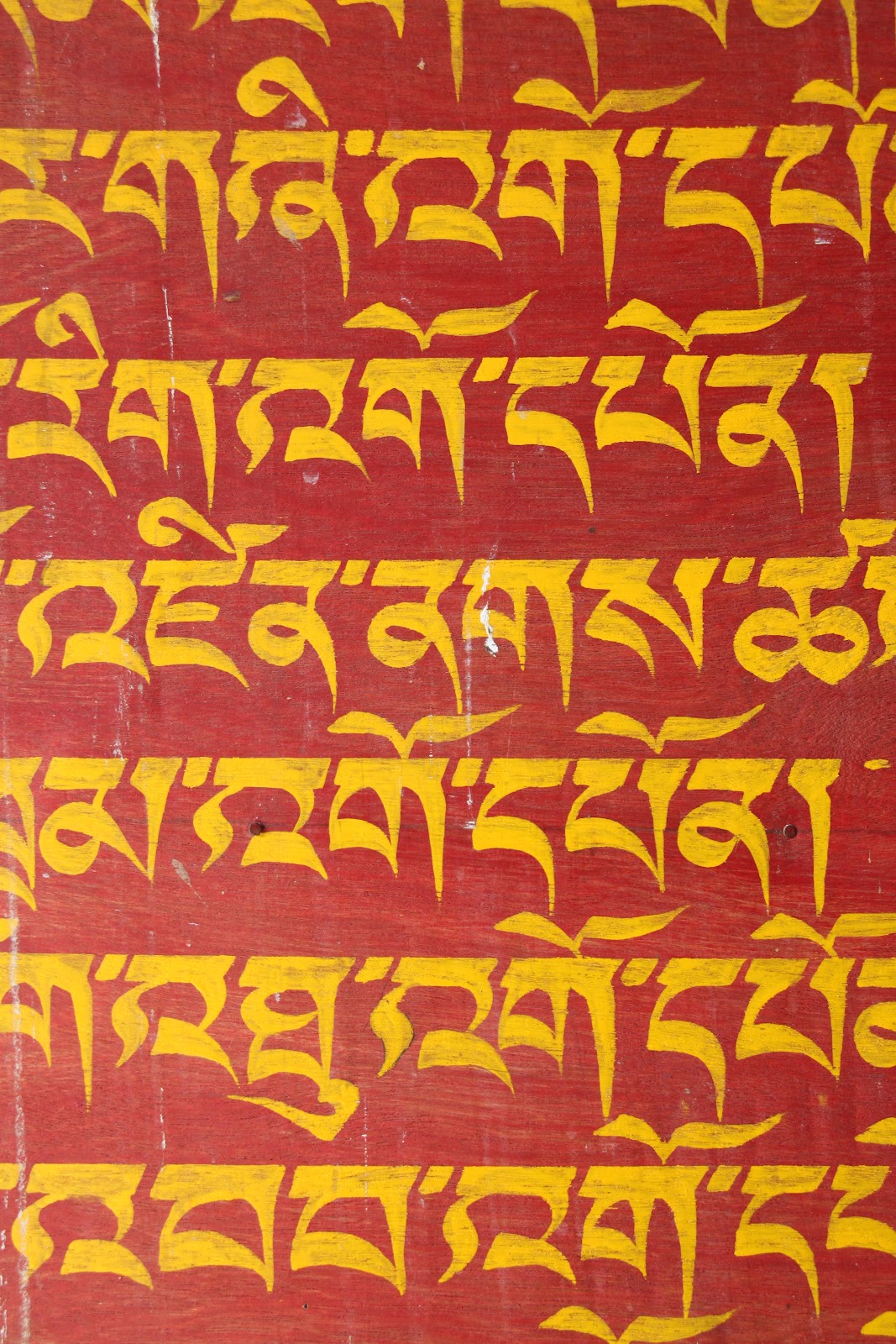
| Dzongkha Script |
 |
| Warding off evil spirits |
The best was saved for last. Punakha, just north of Wangdue, houses the largest and most beautiful of Bhutan’s dzongs. Punakha Dzong sits at the meeting point of the Pho Chhu (father) and Mo Chhu (mother) rivers. It is surrounded by lilac-flowered jacaranda trees under which monks sit in meditation or discussion along the banks of the river. The dzong sits on an island that is linked to the road by a beautifully arched wooden bridge and is illustrative of some of Bhutan’s finest carving, painting, and wood works. The dzong also houses Bhutan’s most sacred and cherished relics and contains one of the most stunning prayer halls in the country, making it a worthwhile venue for last year’s much celebrated royal wedding ceremony between the fifth king and his ‘commoner’ queen. The walls are covered with such fine paintings depicting the transformation of Siddhartha Gautama to the Buddha, and in between are row after row and column after column of gold-plated statues of Buddha and Bhutan’s most revered saints. The most breathtaking are the three beyond enormous gold-plated statues of revered Buddhist figures at the center of the hall, giving the visitor a sense of being in very divine, high energy space.
 |
| The splendorous Punakha Dzong! |
 |
| Gateway to the bridge |
 |
| Gold prayer wheel by another god of direction |
 |
| Stunning wood carving and painting along the door's panels |
 |
| Stunning dzongkha script |
 |
| Civil service officer in front of a stupa and bodhi tree |
 |
| Ornate door to a temple within the dzong |
 |
| More exquisite wood carving and painting craftsmanship |
 |
| A senior monk poses for the camera |
 |
| The old teach the young |
 |
| A congregation of monks outside the main prayer hall |
 |
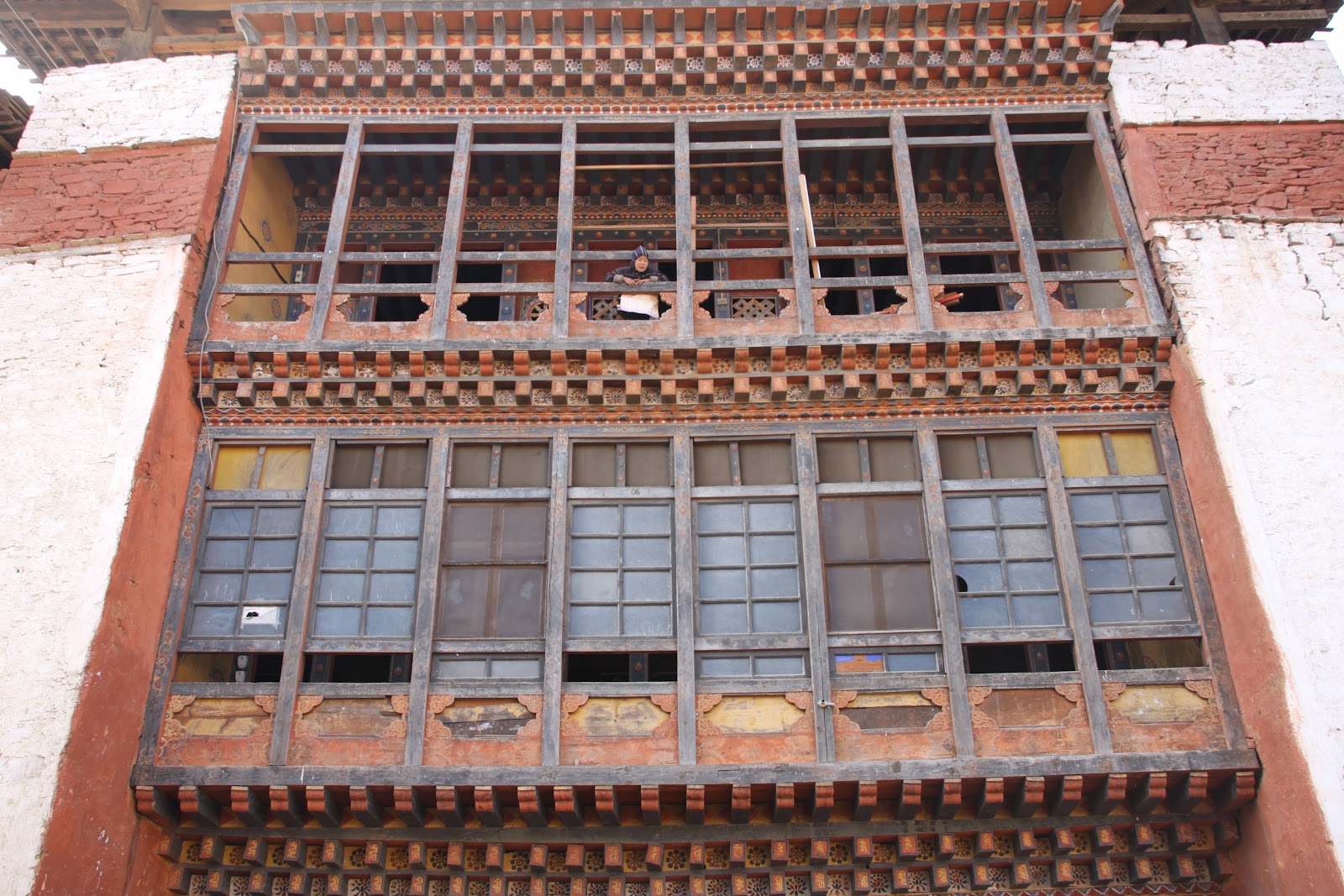
| Ornate carving alongside window frames |
 |
| Entrance to the main prayer hall where the wedding ceremony and king;s coronation took place |
 |
| Another view of the spectacular dxong |
 |
| The Simotkha Dzong |
 |
| Lone monk exits the dzong |
 |
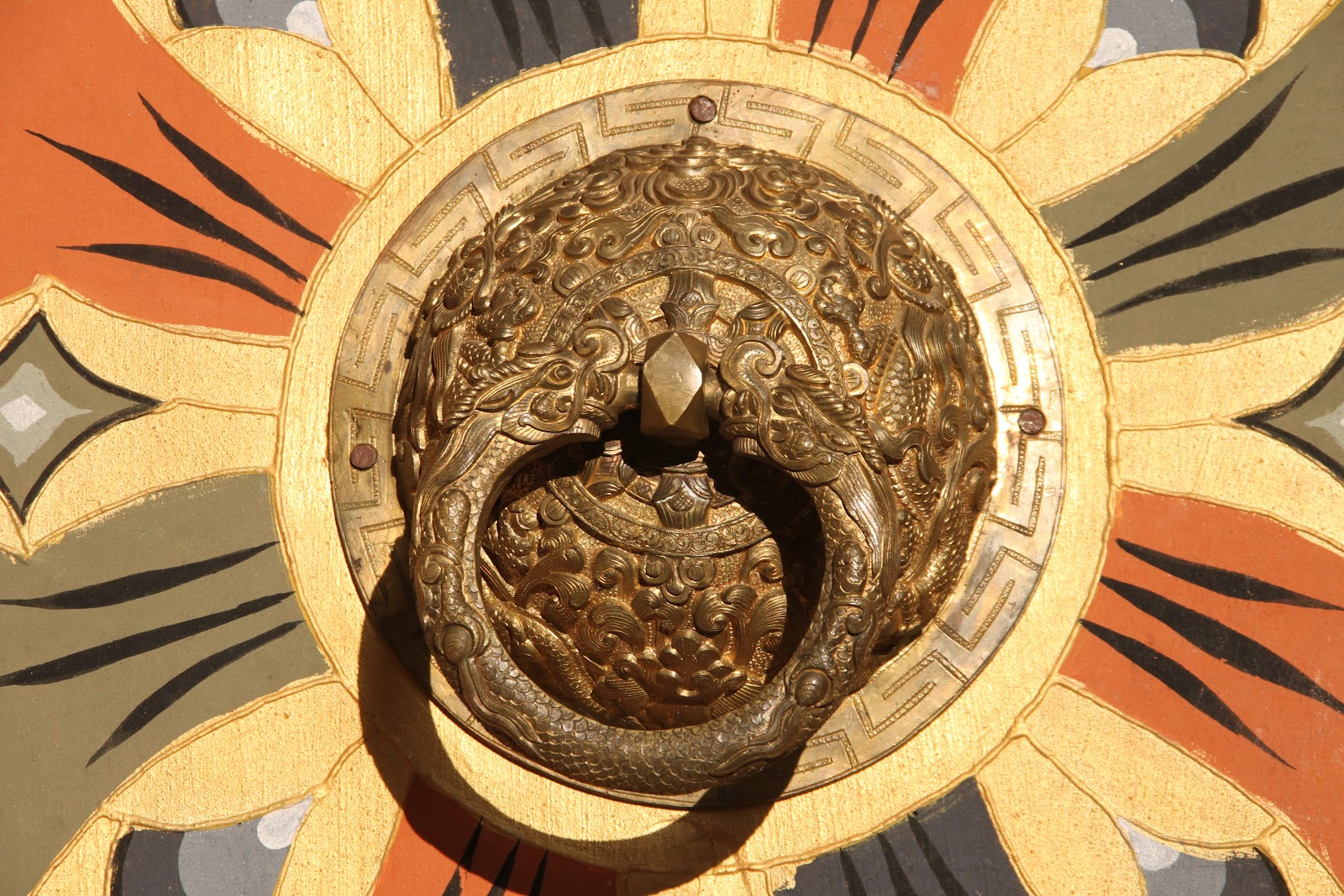
| Brasswork on knob in shadow |
 |
| And, in its full glory in sunlight |
I loved Bhutan and all it has to offer. One day, I will return to explore the eastern, less traversed part of what may be the elusive Shangri La.