Showing posts with label Asia. Show all posts

Friday, August 17, 2012

A Gypsy of Kashmir

Last year in May, I blogged about one of the most captivating life experiences I’ve been blessed with to date. I spoke of the charms and many magical folds of this so-called ‘Land of the Gods’ and was in a photographer’s delirium of delight due to the overwhelming beauty, in both personal features and those of its landscape, the sort that is hypnotic and draws the viewer in, causing one to lose one's self in a surreal world of bliss while at the same time accentuating one's sense of existence.

One photo of a gypsy man I had taken in the mountains of Pahalgam visually captures it all. I was thrilled to learn that this photo will be published in Artists Wanted’s upcoming publication, Exposure.  Check back here for the release date.


A Gypsy of Kashmir


Sunday, June 10, 2012

Back in the Bang

I've just returned from a two and a half week "recon" to Bangladesh, my second in just over a month's span. "I don't envision you traveling much," said my boss upon my signing an employment contract that stated at least 30% travel in my scope of work. Already at a 50% travel rate two months into my employment, I think, "ha!" and am very pleased -- exhausted, at the moment -- but, pleased. And, how opportune that food should feed into dual interests, a personal one that now literally feeds the professional one.  I would never have imagined that I would end up working in a field that literally now takes me into fields and requires me to understand farming and livestock rearing. My Appappa worked for Sri Lanka's Department of Agriculture, and traveled wide and far in the country for his livelihood, and in at least once instance, to India at the time of my Appa's birth.  I would have never guessed in a million years that my profession and interests, particularly in this day and age, would boil to this, and well, here I am, focusing largely (though, not entirely) on market development and production for agriculture. Funny how, in the most unexpected way, we've now come full circle. I wonder what Appappa would have had to say to that. When I was a little girl on one of our trips to Jaffna town, where my Appa's family had finally settled, Amma told me that Appappa took me -- and only me -- in his dusty quaint car to visit our heritage village of Vattakotai. I haven't been back since. O, the conversations we would have enjoyed on those car rides if we could do them now!

The Feed the Future solicitation for Bangladesh to which we are responding is a complex but absolutely fascinating one. The goal of the project is to 'improve food security through strengthened agriculture value chains over a five year period.  To do this requires achievement of several, interlinked outcomes: 1) enhance the economic functions, skills, and production capacity of small holder farmers, women, youth, and the poor along several value chains in Bangladesh; 2) sustainably link these actors to strengthened markets and support services such as appropriate financing or producer group building/strengthening; and 3) promote innovation and research for agriculture-related technology and increase private sector investment into and value addition of agricultural products.  To expand and enhance the market for select sub-sectors (e.g., floriculture, vegetables, coir products, jute), the awardee will also be expected to work with agro-processors, manufacturers, and retailers to strengthen their ability to respond to the demands of a growing middle class market and potential export markets.  All of this will hopefully result in higher financial returns all the way down to the producer household level.  The key cross-cutting component, improving nutritional messaging and practices, will help translate increased income and the production of more nutritious crops into the practical act of consuming these foods, contributing to the overall health of all members in a household.  It will undoubtedly be a challenging program to execute, but to effect change of this breadth and scale for so many lives from the farm to the marketplace would be a very rewarding and humbling experience. 

The competition to win is incredibly intense, and other 'contractors' and their partner agencies have also deployed teams of employees and consultants, who are also scrambling across Bangladesh to gather 'intelligence,' fortify relationships with key partners, and court key staff to assemble winning teams for a winning bid. I don't miss the vulture-like behavior that is a natural reaction to the tendering process; there is a certain thrill in being a part of it that is exhilerating and exhausting all at the same time. Agencies, as per the 'intelligence' that is gathered over years, will budget as much as a quarter of a million dollars' investment towards winning contracts like this one and begin preparation for a bid based on surmise as per country strategies. Once the solicitation is released, the roller coaster ride begins, and all one can do is gear up for an intense 45-60 day period, depending on the time allotted to respond, and say, "Here we go!" Upon submission, the panting comes to a halt, but there's no point in holding one's breath while awaiting award announcements.  Bilateral aid agencies, like our own, can take as much as six nerve-wracking months to make a final decision. And so, we wait the painstaking wait, distracted with having to respond to other bids and deliver on existing projects worldwide.

So, readers, stay tuned for later this year when the final verdict is made. All positive energy is welcome. And, don't forget to not hold your breath!

Friday, May 18, 2012

Whom are you feeding, Bangladesh?

As we rode through the streets of Barisol on cycle rickshaws under the star-filled skies, with our luggage and laptop bags in-hand, I couldn’t resist thinking to myself, “I can’t believe I get paid to do this!” The streets of the town were gradually being filled by pedestrians, auto and cycle rickshaws, and cyclists as stores reopened for business after a second day of hartal or a national strike in Bangladesh, provoked by the kidnapping of an opposition party leader. During a hartal, motorized vehicles and stores are warned to not be in operation, which most comply with with the exception of a few daring (or perhaps, desperate) auto rickshaw and bus drivers. The reaction? Typically, the vehicle is lit on fire, and the driver may face public beating by supporters of the party that has called for the strike. This particular hartal coincided with a two week business trip my boss and I had taken with our partners to study various food value chains that thrive in the southern part of the country. The result was the building up of our knowledge that just skimmed the surface of Bangladesh’s food productions systems and markets from producer to end-consumer. The food journey from the field to our tummies is a good one to know, but even better will be figuring out how to help producers, especially among the poor, enhance the quality of production while earning the incomes they rightfully deserve for feeding their nation’s people, and often times, many of us all over the world. Funding for programs with such objectives come from President Obama’s Feed the Future initiative, through which the current administration has pledged $3.5 billion over 3 years to enhance agriculture production and strengthen food production systems in the less developed world with particular emphasis on increasing food security and improving the nutrition status of the world’s poor. The US government particularly emphasizes that to be food secure, not only must food be available in sufficient quantities, but it must also be accessible to all and utilized by all down to the household level. Women included.

 
I’ve just completed my fifth week with Development Alternatives, Incorporated (DAI) (though, by the time this post is published, it will be eight weeks), one of the largest USAID contractors. I had contemplated making the transition from NGO to a private development firm for some time now, but the jump was postponed when I realized that it would be through working with an NGO that I would attain the necessary grassroots experience and understanding of poverty at the household level--- through exposures less typical in the private development world and critical, in my opinion, to amass as early on in one’s professional career as possible. They profoundly influence the way one approaches development moving forward, and attaining the experience is less painstaking when one pursues it earlier on with a more open, untainted mind and a greater tolerance for “roughing it” or in other words, being able to live like most of the world’s population for a bit of time. What I’ve sought in my new setting is greater diligence, discipline, and efficiency in developing solutions and approaches to poverty that are more systemic in nature. In very simple, general terms, NGOs often perpetuate change in a deep, yet unfortunately less sustainable manner, for a smaller few, while the latter seeks to effect sustainable change through markets and government for the wider many. I believe in this pursuit deeply and desire to explore whether the solutions here truly do impact larger populations in a more sustainable manner.

One of my first assignments has been to prepare for an anticipated bid for a Feed the Future program in Bangladesh that aims to enhance the efficiency (and quality) of production of a range of food and non-food commodities, while better integrating women and smallholder farmers into the system to help increase their incomes and availability, access, and utilization of food by themselves and their families. Given the competitive nature of the USAID tendering process, until proposals are submitted (once the solicitation is released), this post will be limited to some of the constraints we observed during our field visits, rather than embellishing on the solutions we might propose to address these. Welcome back to the world of government contracting.


As I discussed in my post from a visit two years ago to this former piece of India and then Pakistan, Bangladesh is one of the most densely populated nations in the world with over 164 million people residing in a space the size of Iowa! Forty percent of the population and fifty percent of the female population is undernourished. Forty percent of the population currently lives below the poverty line, and the country has one of the highest rates of child stunting in the world. These figures were viciously affirmed as we made our way back to Gulshan-2, one of Dhaka’s more prestigious neighborhoods, from the docks at the end of a brief, yet intense field visit to the south of the country. Because of the continued hartal, we were required to take a launch that took us across rivers, rather than roads, back to Dhaka. Launches are local cruise liners that provide overnight domestic transport between some of Bangladesh’s major towns/cities along river routes. The ground floor typically has no furnishings, and families traveling on general tickets line up side by side on the wooden floors, rolling out their sheets and blankets to sleep on and make the journey a little more comfortable. Launches can be three to four and sometimes more floors high, and the berths can be found up at the top levels. As I entered mine and scanned the bright blue, dusty tapestries, fringed with red and gold tussles and the cockroaches scramming towards shelter under a small, sheet-stained bed, I realized this was going to be another interesting experience. I was also oh so glad that I had followed by instinct to pack an extra set of sheets! My balcony contained a small sink, and a small door leading to my private, en suite bathroom with hole in the ground toilet and all. At departure and arrival, travelers on balconies on neighboring boats could look on to see others brushing their teeth and carrying on with business as usual under the bright neon green and yellow lights of the other boats. It was like being in a mini apartment complex on water.

The journey from the Dhaka docks to our hotel was an eye-opening one. We each hopped onto our cycle rickshaws (as the hartal was still on), and I was wrought with guilt over the laborious journey that my biker would have to make with a load of myself and the luggage that I can never seem to keep to a minimum. As he grew increasingly drenched in sweat, the beads slid down to the tips of his hair before drizzling onto me. What could I say? I wrapped my dupatta up and around my mouth and nose. I was in a predominantly Muslim country, after all. How odd could I have looked?

 
One never sees Dhaka this empty- EVER! It was a luxury to drive through empty roads, but it provided a window into the lives of the invisible, whose livelihoods occur in the wee hours when everyone else is asleep. Men and women of apparent grueling poverty emerged from piles and piles of waste along the roadsides, wearing no masks or gloves, their sandaled feet fully exposed to waste and toxins. A lifetime literally in the gutters spent in dire poverty seemed to have stunted their growth on so many levels, rendering them almost subhuman. I looked on in despair as my insides tightened along with my heart, and I wanted to weep, thinking how can this be? Before I could wallow for too long, I gripped my backpack as I watched in horror the impending collision of an auto rickshaw and an SUV that had dared to venture onto the roads that morning. A loud ‘BANG!’ was followed by the ‘clunk!’ of the rickshaw tipped over onto the road. As we cycled on, I peered back but saw no one emerge from the rickshaw. I prayed that he was alright as well as his rickshaw that was either procured on credit or leased by the day. Who would be held responsible? If the driver was physically harmed, where would the daily income for his family’s sustenance come from until he healed? If the rickshaw was damaged, how would the repair costs be covered? Did the driver, due to ill fate, just land himself in an unexpected lifetime of debt? Three weeks later, I still wonder.

Despite the dark picture I realize I’ve just painted, Bangladesh is a country of great economic potential. In agriculture alone, the country produces such a grand variety of both nutritious foods as well as those whose byproducts are in high demand all over the world. You and I have consumed these products probably without realizing it, such as the jute we find in ropes and cots and the coir (husk fibers) from coconut that are used to make mattresses and floor mats. But, value addition is hardly to be found here. Take vegetables or even flowers, for example, two high potential areas for literal growth here. Both of these are grown in the south west part of the country in large quantities, but smallholder farmers lack the skills and know-how to maximize cropping cycles and the high quality inputs (e.g., seeds, fertilizer) required for quality production of these goods. There are few cooling facilities to be found anywhere in the countryside, and with poor infrastructure and virtually no packing materials, outrageous quantities of waste are seen in these two families of goods. There are no standards for grading and sorting goods before reaching wholesale markets. Farmers are often paid unfair, dismal prices for their produce, bordering exploitation, particularly during the lean seasons for income generation. Most farmers never see the markets because the existing system is embedded with middlemen all along the chain beginning at the farm gates, where most of the goods are collected. The system is rife with chaos and exploitation and perpetuates indebtedness and poverty in a way that we ascertained so unnecessary while studying these systems and chains all the way down to these farmer households.


White buds and marigolds at the Dhaka wholesale flower market (Shahbag Bazaar)


Rickshaw Art


Female wholesaler at Shahbag Bazaar


A woman earns a meager wage for flower petals


Piker or trader selling vegetables at the Dhaka whole horticulture market (Kawran Bazaar)


Guess who's the wholesaler in this picture?


Traders within the wholesale market


Women bear much of the brunt of this system. They contribute immensely to production, and while prohibited to buy, sell, and engage in the marketplace, are given no choice when it comes to executing the back-breaking and labor-intensive aspects of production. Perhaps due to socio-cultural and religious inhibitions, the very women in the field sowing and harvesting are unable to engage in decisions on what inputs to purchase, what to grow, and when to grow it. Even when extension services are available to disseminate these skills and knowledge, in the current system, women cannot engage with these service providers. Women are rarely permitted to engage on the front end of business, but of course, back end work as the invisible laborers is perfectly acceptable. Women are the last to eat in a household and often end up with very little to consume in both quantity and nutritious value. These women literally create the next generation, and the cycle is perpetuated. So, there you have it.


The only instance where women are visible in the vegetable market- selling the collected, unsellable scraps down market


Tea and bread- where is the nutrition??


Collected scraps are made to "look nice" and then sold to a lower marget segment


The unsellable unsellable scraps can go even further down market


Our team studying jute production in Faridpur


Raw jute being transported to a local factory for processing


Unhusked rice


Now, can you guess who the wholesaler is? Clue: stomach size


Piker auctioning tiger shrimp to buyers


Bepari (also trader) at the fish wholesale market in Barisol


It has been one insightful experience, and I must say, an optimistic one. All the issues laid out here have very clear solutions and are rectifiable. This is wonderful news! The challenge is to articulate these solutions and carve out implementable approaches that are going to tackle these obstacles in a deep and sustainable way. My fear? Much of this change is likely unwanted by a few and powerful. Some of the constraints require a deep-rooted change at the socio-cultural level that seeps into the very psyche of a massive population. How we approach our market solutions is the focus of the next couple of months, but the much-needed behavior change will be among the first of the challenges we will face in the field if and when we win this opportunity.


Friday, March 2, 2012

Dzongs, Lhakhangs, and Everything In Between

Normally, I dedicate a good amount of travel-related posts to describe the gastronomical experience that each place I visit has to offer.  I regret to say that Bhutan will not receive that same effort, particularly so after my first exposure to the local cuisine in Thimphu, Bhutan’s capital city for the last fifty years or so.  I had largely been fed Indian food in the accommodation in Paro and finally requested to taste some local, more authentic dishes.  So, in addition to dhal and chicken do pyaza, I was also served three dishes typical to Bhutanese cuisine--- chilies with cheese (emadatse), potatoes with cheese (kewadatse), and red rice.  Suffice it to say that while they were pleasant to the palate, I am highly doubtful I’ll ever develop a craving for these again.  When I requested a soft drink to accompany my dinner, I was served a Tiger beer by a young waitress, who was subsequently scolded by the older waiter for getting my order “wrong.”  When I acknowledged that I’d agreed to have the beer, he, to my humor, felt the need to reconfirm twice that I would in fact opt for the beer over a soda.  After all, the order surely must have been misunderstood if a South Asian woman had voluntarily opted for an alcoholic beverage!   

Thimphu is the only capital city in the world with no traffic lights.  Traffic police have actually come to be a tourist attraction, particularly as they robotically and theatrically direct traffic in twenty-five minute shifts.  The city feels like more of a medium-sized Swiss town, but its rich art scene and abundance of cultural and religious sites add tremendously to its colorful legacy.  Our first stop today was to the National Memorial Chorten, built in memory of Bhutan’s third king.  Several Drukpa (people of Bhutan) start their day here in worship, circumambulating the massive stupa in the center at least three times, spinning their prayer wheels and chanting, “Om Mani Peme Hum,” which roughly translates as, ‘hail to the jewel in the lotus.’  Behind the stupa is a prayer hall, where monks perform rituals for the deceased of those who can’t afford to finance a traditional Buddhist funeral.  Today, I got to witness such a ritual being done as monks chanted, while others blew on the dunchen, a long trumpet-like instrument that rests at an angle on the ground while the seated blower rests the mouthpiece on his lips to play.  Upon entering the grounds, massive prayer wheels were being spun by the aged as they devoutly sat in prayer with their packed meals by their sides.  They had a very long day ahead of them!


National Memorial Chorten


Worshippers circumambulating the Chorten


Worshippers with beads and prayer wheels in hand


Prayer for the day


Turning prayer wheels for another 8 hours ahead


The National Memorial Chorten


Bhutan is peppered with dzongs and lhakhangs, which are the main tourist attractions of the country.   But, Thimphu, being the cultural center, also offers visitors a chance to visit their many painting and handicrafts schools.  The most holistic is the National Institute of Zorig Chusum, which is committed to preserving and teaching students the thirteen traditional arts and crafts of Bhutan --- shing zo (woodwork), dho zo (stonework), par zo (carving), lha zo (painting), jim zo (sculpting), lig zo (casting), sga zo (wood turning), gar zo (blacksmith), troe zoe (ornament making), tsha zo (bamboo work), de zo (paper making), tshem zo (embroidery), and thag zo (weaving).  Interestingly, however, most handicraft stores sell an abundance of Nepali and Tibetan goods that are brought across the borders for selling to tourists.  Prices are often marked up by double, triple, and even quadruple their selling price in their countries of origin, which is a little disappointing for the eager shopper like me.

One of the most famous temples of Bhutan is in Thimphu – the Changangkha Lhakhang, whose main deity is Chenrizig, the eleven-headed, thousand-armed avatar of the Buddhist deity Avalokiteshwara, lord of the world.  It’s a small but old temple, famous for its black and gold prayer wheels lodged into its white-washed walls.  Couples bring their newborns here to be named, sometimes after the temple itself.  


Changangkha Lhakhang


Black and gold prayer wheels of the Lhakhang


Takin, the national animal of Bhutan!


Nuns at the Zilluka Nunnery 'yellow-washing' the papers of mantra to be slipped into prayer wheels


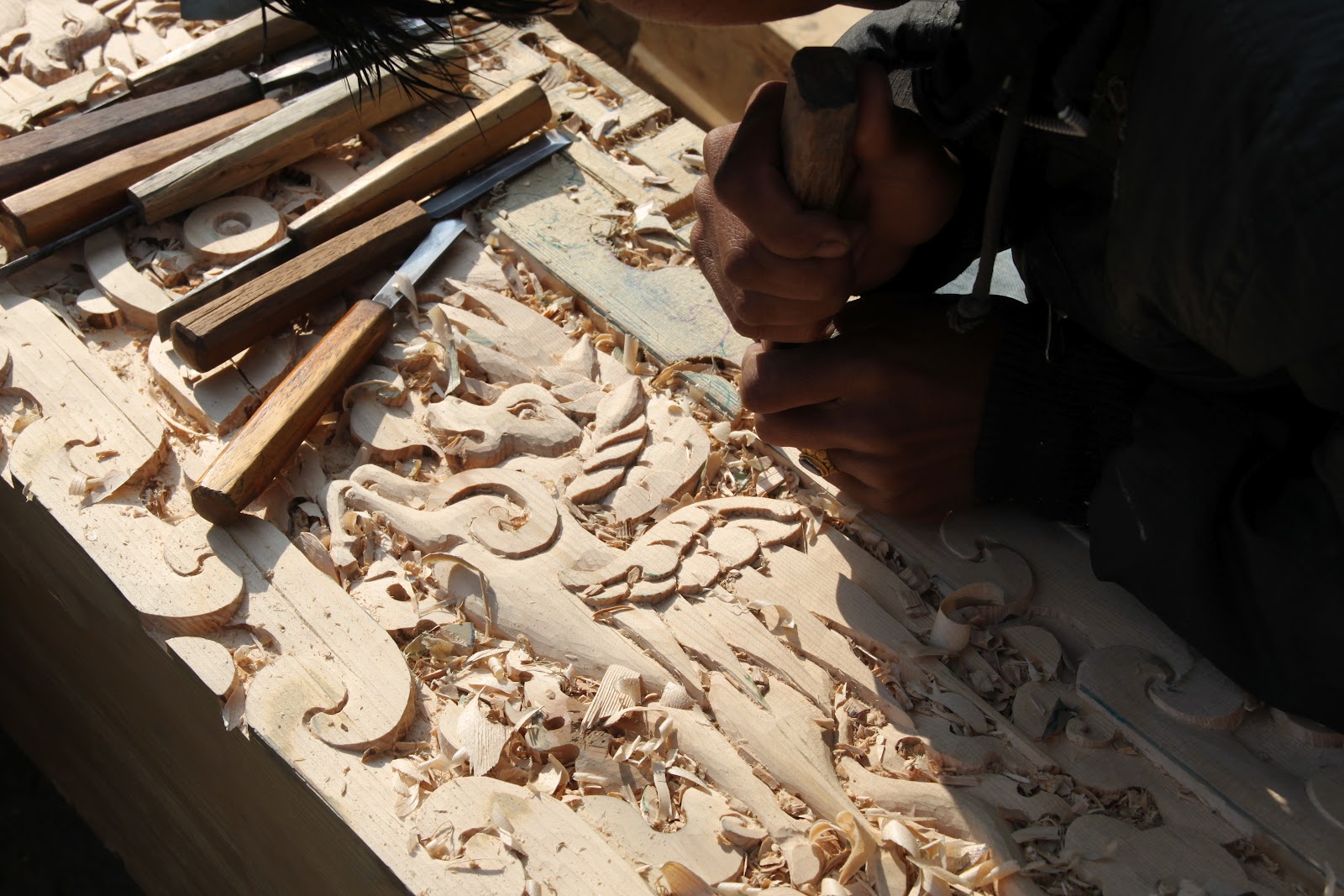
En route from Thimphu to our next stop in Wangdue, moving slightly southeast of Thimphu, we passed through the Dochula Pass, from which point the elevation drops rapidly as one moves eastward.  The turning point is marked by a stunning shrine that the fourth queen had built in honor of her husband.  The Druk Wangyal Khangzang Chhortens are one hundred and eight white-washed stupas with black and gold Buddhas carved within apses on each of their four faces.  The view of the Himalayas is stunning from here on a clear day.  After two hours’ drive from here, we reached the very windy town of Wangdue, famous for housing one of the oldest dzongs in Bhutan.  When I visited, it was under renovation with hundreds of workers, including school children on winter break, carrying loads of materials to and fro while monks distributed water bottles.  Here, we had the opportunity to watch some of the young craftsmen at work, carving and painting the new pillars and roof ridges that would soon ornament the renovated dzong.  It was spectacular!


The Druk Wangyal Khanzang Chhortens


White-washed chhortens against a moon backdrop


The primary chhorten


Black and gold Buddhas


Entrance to Wangdue Dzong


Massive prayer wheel by a god of direction


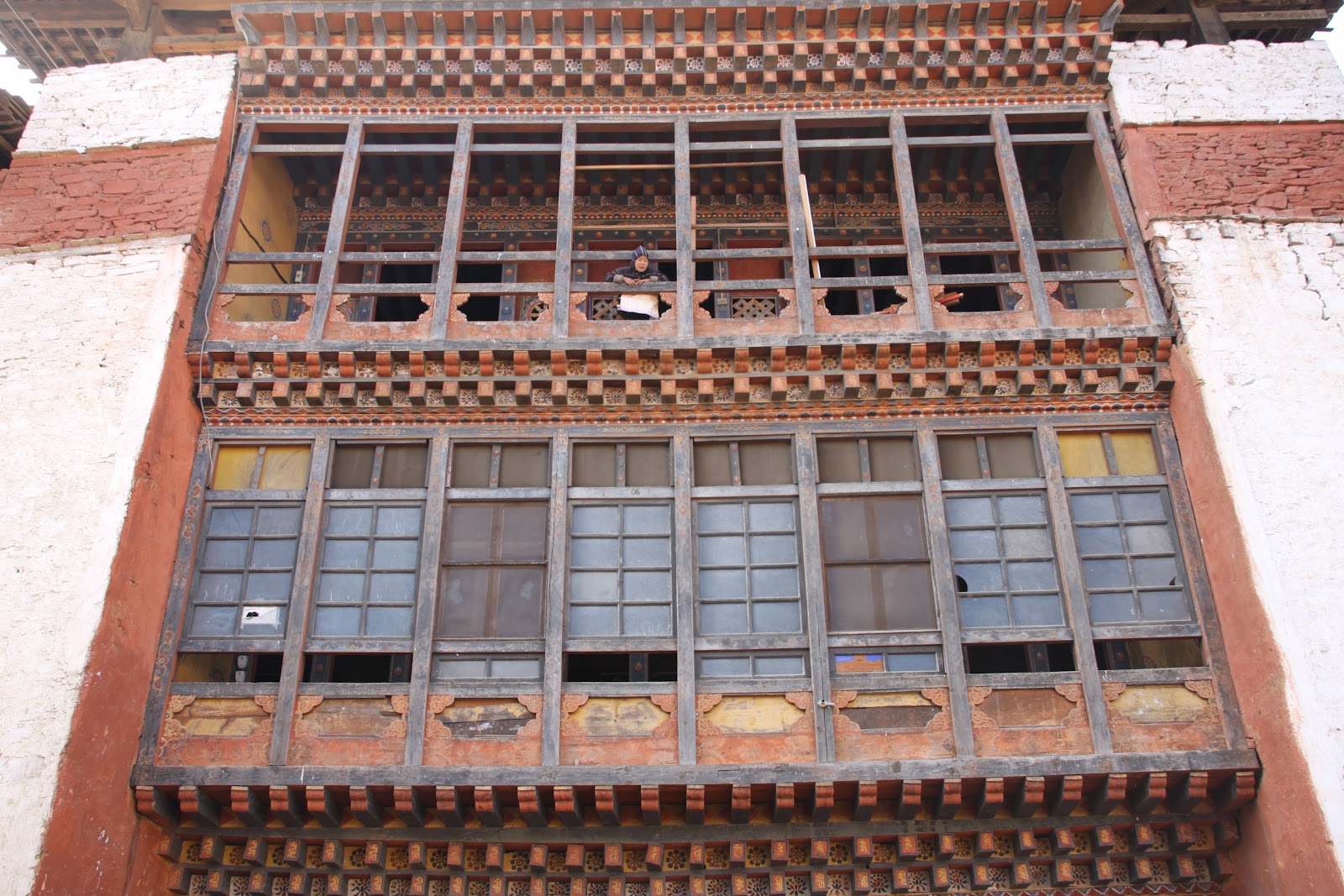
Under renovation

Craftsman at work


Say hi!


Original prayer wheels of the dzong


A volunteer folds festival hangings


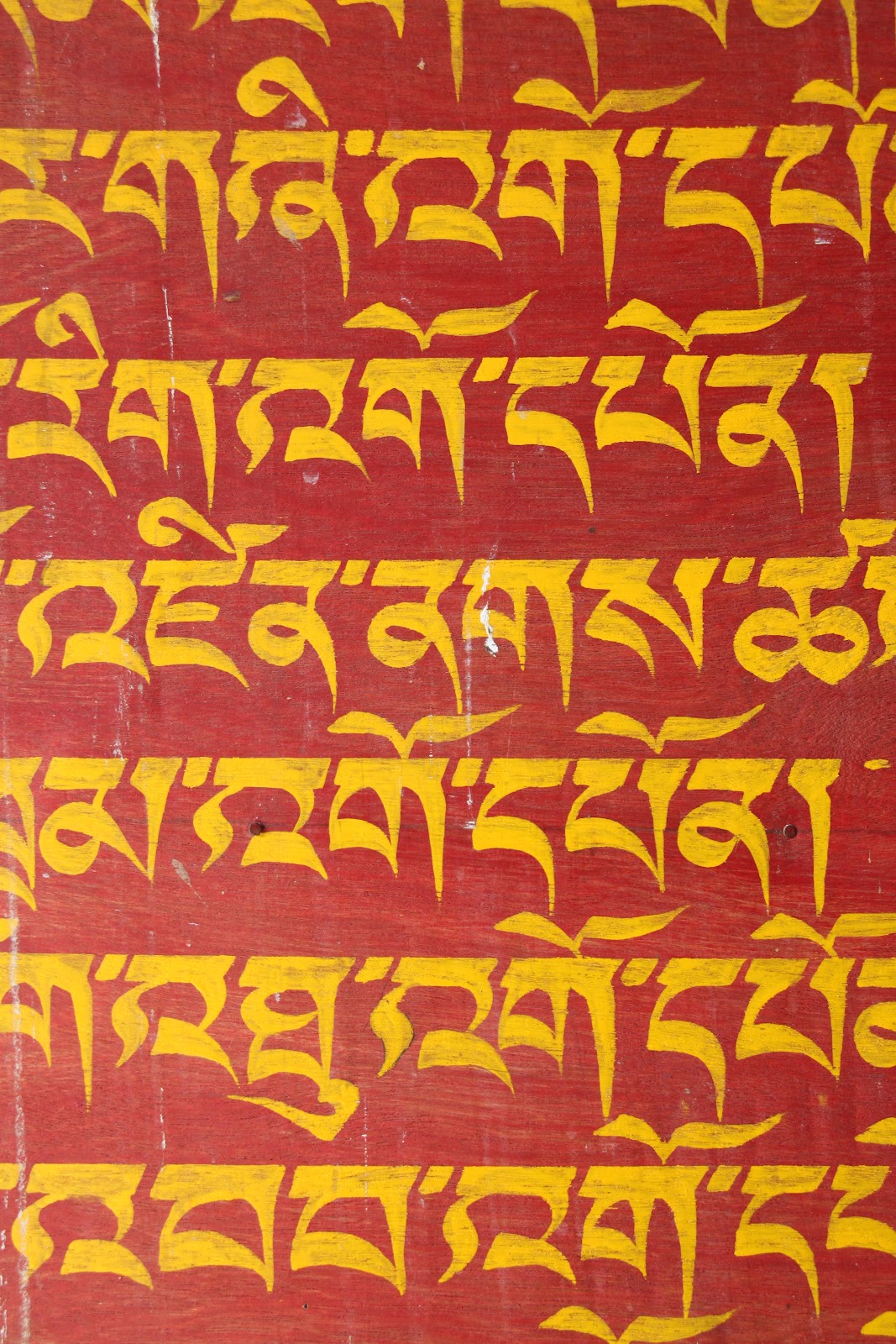
Dzongkha Script


Warding off evil spirits


The best was saved for last.  Punakha, just north of Wangdue, houses the largest and most beautiful of Bhutan’s dzongs.  Punakha Dzong sits at the meeting point of the Pho Chhu (father) and Mo Chhu (mother) rivers.  It is surrounded by lilac-flowered jacaranda trees under which monks sit in meditation or discussion along the banks of the river.  The dzong sits on an island that is linked to the road by a beautifully arched wooden bridge and is illustrative of some of Bhutan’s finest carving, painting, and wood works.  The dzong also houses Bhutan’s most sacred and cherished relics and contains one of the most stunning prayer halls in the country, making it a worthwhile venue for last year’s much celebrated royal wedding ceremony between the fifth king and his ‘commoner’ queen.  The walls are covered with such fine paintings depicting the transformation of Siddhartha Gautama to the Buddha, and in between are row after row and column after column of gold-plated statues of Buddha and Bhutan’s most revered saints. The most breathtaking are the three beyond enormous gold-plated statues of revered Buddhist figures at the center of the hall, giving the visitor a sense of being in very divine, high energy space. 


The splendorous Punakha Dzong!


Gateway to the bridge


Gold prayer wheel by another god of direction


Stunning wood carving and painting along the door's panels


Stunning dzongkha script


Civil service officer in front of a stupa and bodhi tree


Ornate door to a temple within the dzong


More exquisite wood carving and painting craftsmanship


A senior monk poses for the camera


The old teach the young


A congregation of monks outside the main prayer hall


Ornate carving alongside window frames


Entrance to the main prayer hall where the wedding ceremony and king;s coronation took place


Another view of the spectacular dxong


The Simotkha Dzong


Lone monk exits the dzong


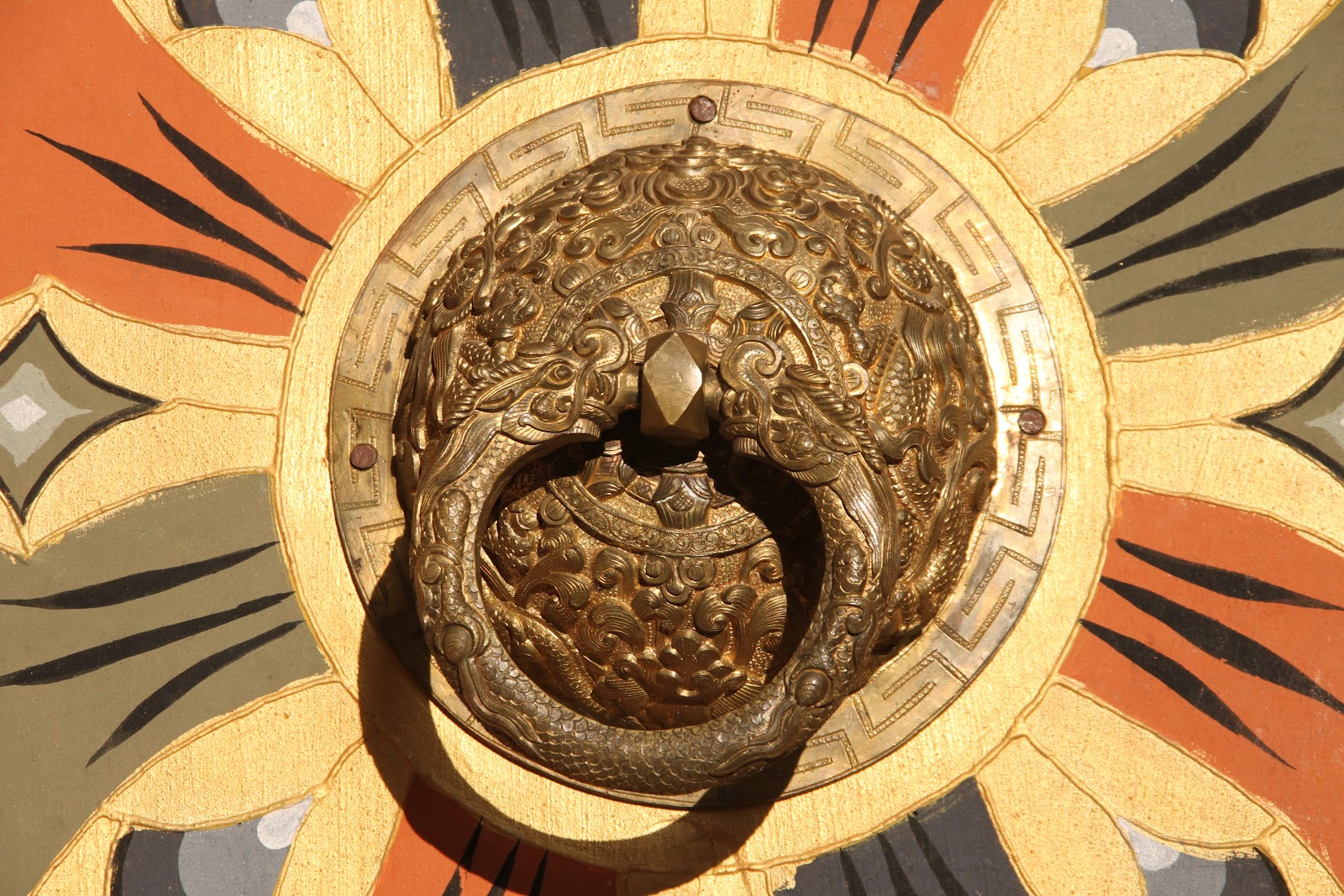
Brasswork on knob in shadow


And, in its full glory in sunlight


I loved Bhutan and all it has to offer.   One day, I will return to explore the eastern, less traversed part of what may be the elusive Shangri La.