Wednesday, June 23, 2010

Enlightening Exposures in Gaya, Bihar

My professional and leisure travels this past year have inadvertently taken me through three of Buddhism’s four most significant sites from Lumbini, Nepal, where Siddhartha Gautama was born and became witness to the three tragedies of mortal life, to Sarnath, where Buddha gave his first sermon after enlightenment. During my trip to Bihar earlier this month, I was taken to Bodh Gaya, where Buddha ostensibly gained enlightenment under the neem tree that continues to draw pilgrims and devotees aspiring for the same. Interestingly, it was the high poverty levels characterizing the areas surrounding these holy sites that ultimately incited my visits, and admittedly, I can’t help wondering what the correlation is between the two, if any.

After spending a night in Patna, Bihar’s capital, we traveled to the district of Gaya to conduct field visits as part of the area identification process for the pilot program discussed in the last entry. We engaged in discussions primarily with the women of some of the poorest villages in Gaya, where mainstream microfinance has very little or no reach. Government schemes targeting these individuals are often politicized and tend to benefit those with links to the local elite, including acquiring Below Poverty Line (BPL) cards which qualify individuals for such assistance. Our meetings were conducted in vacant school houses or under a community tree in the sweltering and harsh +120˚ heat of India in villages deprived of running water, electricity, and basic infrastructure.


Female members of an 'extreme poor' village in Gaya


Children observing the village meeting on poverty

As the women relayed what they considered to be the biggest challenges for generating more reliable incomes, I noticed the young girls just outside the classroom rolling the mounds of scented black clay-like substance into agarbatti or incense sticks. I learned that Bihar is one of India’s largest producers of the product, and middlemen from the supply chain provide rural women enough of the raw materials for roughly 10,000 sticks to be handed over in exchange for only wage labor at the end of each week. They, then, sell the near finished or packaged product at a much higher price than the input cost and reap a handsome profit. Income generation through exactly such means keeps these women and their households in extreme poverty because they don’t benefit from the profits of at least reselling the value-added near finished product back to the middleman or directly in the market. Rather, they are exploited for their labor and paid atrociously low wages. Some women have taken loans to purchase the raw materials themselves and take better control of their income generating potential, but how many women can profitably become agarbatti producers without saturating the market? Our answer is diversifying income streams.


Female SHG members gather in Bela block of Gaya district, Bihar


Children playing among the agarbatti production


SHG members share their challenges with us


After several days of such intense exposures, the visit to Bodh Gaya served as a convenient reprieve. The tree under which Buddha attained enlightenment still stands behind a newly constructed temple to commemorate the auspicious site. Pilgrims and tourists from all over the world, but predominantly from East and South Asia, were numerous. I was reminded that even with a thriving albeit relatively small tourism industry that clearly attracted high revenues in the form of donations, charity, and fees, without a commitment from the state government and private sector, that wealth would never be seen by most Biharis.


Mahabodhi Temple in Bodh Gaya


Mini stupas surrounding the temple grounds


At the rear of the temple under the tree where it all happened


Front of the Mahabodhi Temple


Buddhist statues in the naves of the temple


Bihar, surprisingly, has a wealth of historically and religiously significant sites, including Nalanda, the ancient Buddhist center of higher learning from 427 to 1197 CE. Its library was one of the eastern world’s greatest treasures and attracted scholars from China, Greece, and Persia. Ostensibly, the library’s collection was so immense that it burned for three months after it was set on fire at its downfall.


Sariputta Stupa at Nalanda University


Back of the Sariputta Stupa


Another view of the temples srrounding the stupa


As we prepare the launch of our pilot program, I’m gearing up for another set of field visits in this once forlorn part of India. Stay tuned for updates.


Friday, June 11, 2010

From Bottom Billion to Next Billion

Prior to joining GF, while conducting an impact assessment for a savings and credit cooperative in Nepal, I saw how poverty cannot be addressed solely by financial means. Particularly for those living in extreme poverty, the solution cannot be limited to providing access to microfinance’s traditional product: an enterprise loan. During the fifty interviews I conducted for the assessment, nearly all the clients claimed that had they undergone appropriate skills development or received training on value addition for the goods and services they were selling, their microenterprises could have generated the additional income required for them to sustainably progress out of poverty. The Solutions for the Poorest team at GF is joining a small but growing group of microfinance practitioners that recognize this and are looking at how microfinance can incorporate new ways of doing business that better meet the needs of the very poor. One approach we are testing couples livelihoods support with microfinance in a financially sustainable manner, contributing to what has been termed the “double bottom line.”

Solutions for the Poorest has partnered with BASIX/The Livelihood School India, a pioneering livelihood promotion institute, in this pilot project. On April 13-14, 2010, we kicked off the partnership with a Consultative Workshop on Solutions for the Poorest at the Chandra Gupta Institute of Management in Patna, Bihar. We began working together to design an integrated and sustainable methodology to provide financial and non-financial services to the extreme poor that BASIX would not typically serve through its mainstream microfinance activities. Microfinance practitioners and academics such as Bandhan’s CEO, Chandra Shekhar Ghosh, and Dr. Manesh Choubey from the Center for Microfinance Research shared key learnings from their own experiences in working with the poorest, resulting in a successful exchange of ideas that will help effectively shape our own program.

To broaden our understanding of existing pro-poor microfinance initiatives, my colleague, Malini, and I also travelled to Calcutta to visit Bandhan’s Targeting the Hard Core Poor (THP) program. THP targets female headed households with no or very erratic income opportunities and provides them with the skills and assets required to jumpstart a microenterprise. This support, supplemented with confidence-building measures, cultivates a seemingly limitless entrepreneurial spirit.

One such inspiring example was Shahida Bibi, who with her seven children and disabled husband, survived on a weekly income of $2 Shahida earned as a housemaid. Without any productive skills and regular income, Shahida was not considered creditworthy by other MFIs. THP provided her with four goats eighteen months ago to help generate a more consistent income stream that has allowed Shahida to provide for her family while also nurturing the habit of savings. Since then, she sold one goat for $43, then diversified her income stream by buying chickens and selling eggs, and later by selling coconuts and vegetables to her neighbors. Shahida is a client many microfinance institutions would have overlooked previously, but has now grown into a real business woman, generating a weekly income of $43, and already planning for additional ventures.

Having the opportunity to practically address the issue of global poverty in a holistic way has made the past month’s immersions in Solutions for the Poorest initiatives an intellectually stimulating and inspiring experience. I look forward to continuing our work to propel the bottom billion into the next billion.


SHG members gather in Maner, Bihar


Bandhan THP client with produce from her own farm


Bengali script on wall advertisement


Children of Bandhan THP clients in West Bengal


SHG members in Maner, Bihar


Edited version published on Grameen Foundation's Creating a World Without Poverty.

Thursday, April 8, 2010

Visits to a Divine Abode

Nepal and the mystique surrounding it seem like a far away dream. Now back in Washington, DC, only the photographs seems to verify my memories and some of the most fascinating adventures trekking through the Himalayas. When I realized that my time in Nepal would be cut short with the start of a new job, I was devastated that my trekking trip through Tibet, kora (pilgrim circumambulation) around Mount Kailash, and Everest base camp excursion would all have to be put on hold until another point in my life when I’d have that much personal freedom and leisure time. I hastily put together a list of the key sites and activities I had to experience before returning to the dull West. One was to complete at least a three-day trek in the Annapurna region of the Himalayas, and another was to receive a glimmer of the Everest’s dharshan on a Buddha Air flight.


The trek began from Pokhara, the city of the beautiful Phewa Lake, which I write about in “A Little Taste of Heaven.” After an early morning flight from Kathmandu, two sherpas, met me at the airport and we began the journey into the Annapurnas. As we started the journey, the Sherpa serving as a porter ran ahead of us with ease as he carried the weight of our entire supplies and personal belongings for the next three days. While not a long period, so the supplies were limited, it was still a heavy load, and I was in awe of the weight that the sherpas have been accustomed to carrying on their shoulders and backs for generations- as much as 500 kilos! We trekked along the Seti Gandaki river for several kilometers before beginning the high ascent into the more mountainous terrain through remote villages amidst lush greenery and the rhododendrons that adorn the trekking route to Ghandruk.


Flowing waters of the Seti Gandaki


Mules bringing supplies into the remote villages of the Himalayas


Sherpa carrying supplies across one of many bridges through the range


Grazing mule along the river banks


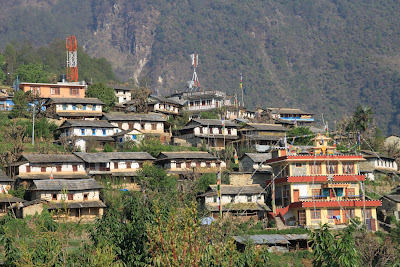
Himalayan village


The views from Landruk and Ghandruk over the course of the three day trek were overwhelmingly breathtaking, and I feel blessed to have been so close to some of the highest, monumental peaks in this world. The Annapurna range is crowned by the Machhapuchhre twin peaks (meaning ‘fishtail’) and studded for miles with other captivating snow-capped peaks overlooking the tribal villages laced with the Nepali prayer flags.


View of Annapurna range from my Landruk guesthouse


A closer view of the Annapurnas


Even closer...you can't get enough of this beauty!


Residents relaxing on their stoops in the evening as we walk on


A Gurung woman sitting outside her hut


The morning before my first field visit to Bihar with the Grameen Foundation, I caught a Buddha Air flight that takes a small number of passengers along the Himalayan range up to the renowned Mount Everest before making a full circle back to Kathmandu. While it by no means compares to seeing Everest from its base camp, one can’t help but feel awestruck by the sight of it, even from the cockpit of the plane. The Himalayas, meaning “abode of snow” in Sanskrit, conjures all sorts of magical images in our minds and continues to profoundly shape the many colorful cultures of South Asia and beyond. It is the mother of several sacred rivers flowing through the Asian continent from Tajikistan to Vietnam and will forever be honored as such in our hearts.


The Himalayas!


Another view of the breathtaking Himalayas


Everest in the distance


Goodbye for now. I will be back.


Friday, April 2, 2010

Microfinance and Enterprise Development in Bangladesh

At a lecture presented at the University of Oxford’s renowned Sheldonian Theater, Grameen Bank’s founder, Professor Muhammad Yunus, stated that “not only is poverty the most pressing issue of our time…it is [also] a problem that we have fully the capacity to tackle and overcome within the first half of the century--- if we choose to do so.” The greater industry of microfinance has evolved from pockets of small-scale programs of limited scope to a diversified and dynamic one that engages several actors in the innovation of more effective methodologies, products, and services to better serve the poor. During my time in Bangladesh, I had the opportunity to visit both Grameen Bank and BRAC’s programs at the field level to gain a better understanding of their approaches in practical terms.

Grameen Bank
Poverty is not a symptom of the poor but rather an outcome of social and economic policies borne out of existing institutions and frameworks. The current banking system is one such financial institution, and as Yunus mentions, is fundamentally flawed when it excludes more than half of the world’s population because they are not deemed credit-worthy. The Grameen Bank was established to develop a banking method which can deliver financial services to those left out of the formal system, particularly women, whom are hardest to reach in most of the world.

I won’t go into the details of the Grameen methodology, structure, and financial products and services here. There are numerous online publications detailing these topics, including the Grameen Bank’s official website. Of Grameen’s 8 million borrowers, 97% are female. Loans are made without guarantees, collateral, or tedious paperwork, however, generally, clients are required to be members of a registered group of 5-10 like-minded individuals who are not blood-related, share a common level of education, are permanent residents of the same village, and are landless*/assetless. Functioning primarily on an honor-based system, Grameen permits a great extent of flexibility on loan repayment schedules without charging penalties, and as of 2008, its repayment rate stood at 98%. An internal survey demonstrates that clients are steadily crossing the poverty line each year with 64% of borrowers, who have been members for at least 5 years, having already crossed the poverty line.

The general structure of Grameen Bank is a hierarchical one, which follows: group → center → branch → area office → zonal office → head office in Dhaka. During my field visit, I visited a center-level meeting for income generation loan clients and the branch office and met with the area office manager in order to get a brief exposure to the most grassroots segments of the structure.

The center level meeting was comprised of approximately 8 groups and was held in a tin structure constructed for the purpose of such weekly meetings. The clients we met were all women, and most were engaged in the business of selling gold scraps stripped from coal to jewelers. During the center meetings, clients engage in loan repayments and weekly savings depositing, followed by requests for new or supplemental loans. During the latter, all members of the applicant’s group must be present and affirm that the purpose and amount of the request is valid. The center head’s opinion and approval is also sought, particularly on the applicant’s ability to repay the amount requested. Within the subsequent week, the branch officer presiding over the meetings conducts her own due diligence of the applicant. The request, if approved, is then proposed to the branch manager, who conducts additional due diligence before approving and sharing with the area manager for approval. Once the application is approved, the branch officer prepares the amount for disbursement, and the applicant is notified at the subsequent center meeting that her loan amount is ready for collection. The repayment schedule, distinguishing principle and interest, is shared with the client at the time of collection to ensure that she is aware of her repayment requirements and options.


Grameen clients gather for the center meeting in Dhumrai


Husbands of the clients contributing to the gold stripping process


Clients deposit their weekly savings and loan repayments during the center meeting

Vehicles could not transport us to the site of the village and the center meeting venue. From the nearest village, we were required to walk a few kilometers before hiring a villager to transport us the remainder of the way on something similar to a rickshaw. We were visiting a center hardly considered remote, presenting just a sliver of the effort Grameen has taken in bringing banking to the poor.


Village children playing with an abandoned fishing boat

BRAC’s Ultra Poor Program
BRAC is the world’s largest NGO, initiated from Bangladesh and now, with offices throughout the world. The agency is also renowned for its work in microfinance and its integration with enterprise development. DABI for poverty alleviation for poor, landless women and Unnoti, providing enterprise development support for marginal farmers, are based on a group lending model, whereas Progoti, which provides enterprise development support for micro and small entrepreneurs, relies on an individual lending model. This integration of microfinance with technical support, provision of high quality inputs, and marketing is called a credit-plus approach and demonstrates a more innovative way of making access to finance an effective tool to bring people out of poverty.

I spent more of my time focusing on the organization’s Ultra Poor Program, which aims to reach the poorest within communities in Bangladesh. Though the program is grant rather than credit-based, it addresses the larger question of how to serve the poorest of the poor. At present, most microfinance programs target those lingering around the poverty line (a little over $2 per day) and assume that those well below the poverty line ($1.25 per day) are not capable of making credit a productive asset to create a diverse set of income generation sources for themselves. This group, with BRAC and other agency support, are proving otherwise.

The income of the ultra poor is even more irregular than that of the poor, and expenditure for matters of survival other than food is zero. Income is generated from begging and most often generated by children of school-going age. After a series of social mapping and grading of solvency, households are selected to participate in the program, through which they receive vocational and other training in income generation activities, assets to engage in the activity, a daily allowance and healthcare to facilitate their success, and ongoing mentoring for up to three years. To complement this, beneficiaries’ communities are mobilized to form poverty alleviation committees to ensure that community members are more intimately involved in the program and are motivated to provide their support to ultra poor members. This understanding nurtures more intimate relationships among the community members and creates a sense of responsibility and achievement as communities, as a whole, are uplifted.

Actors within Bangladesh have made great strides in addressing poverty through innovative means. Their success has spurred inspiration and replication of similar programs throughout the world. When I received a call from Grameen Foundation USA offering me a position with their Solutions for the Poorest unit while I was coincidentally visiting these initiatives, it seemed to be destiny, and I accepted. This month, I will start working with the unit to design and execute pilot programs testing the “downscalability” of integrated and value chain approaches of microfinance and enterprise development. We will start in India, and when successful, will expand this mission on a global scale. A choice has been made, and the journey finally begins.

*landless = less than 50 decimals of land


Saturday, March 27, 2010

Bangladesh in Two Weeks: Dhaka → Jessore → Khulna → Bagerhat → Mongal Port → Sundarbans → Dhaka → Dhumrai

Earlier this month, I traveled to Bangladesh with the primary intent of visiting two of the microfinance field’s premier institutions, the 2006 Nobel peace prize winner, Grameen Bank, and BRAC in order to gain insight into a different set of microfinance/microenterprise development models developed to address the larger issue of poverty. The trip also served as an ideal opportunity to explore another part of South Asia, unique in its blend of cultural, religious, and linguistic character.

Dhaka is the city of rickshaws (400,000 run each day), which may possibly be the primary mode of transportation for its 16 million inhabitants by day and 13 million inhabitants by night. The sites of Dhaka are diverse in architecture, mirroring its history as part of several Indian Hindu dynasties, Buddhist kingdoms, the Mughal empire, British Raj, and East Pakistan before evolving into the modern capital city of the 1971-established Bangladesh.


Rickshaw drivers awaiting business outside the Pink Palace

The city is situated along the Buriganga river, and its Sadarghat serves as a lively economic center, where merchants and clients engage in the buying and selling of a variety of goods.


Boatmen of the Buriganga River


Trading at Sadarghat


The lone boatman

Religious shrines and monuments are in abundance, and Dhaka is believed to have been named after the Dakeshwari Hindu temple, honoring one of the many forms of the goddess, Kali. Azaan can be heard five times a day, and the melody and vibrations never cease to stir my soul, evoking an overwhelmingly surreal divine sensation tugging within the depths of my core. The Star Mosque (Tara Masjid) is one of the most ornate mosques of the city, studded with blue star motifs and colorful shards of Chinese porcelain. After visiting this piece of history, we moved on to the Lalbagh Fort, which is an incomplete Mughal palace fortress that was abandoned after the death of the daughter of the Mughal leader at the time, Shaista Khan.


View of the Lalbagh Fort upon entering


Dormant at the Fort


The Tara Masjid


Ornate decor of the Tara Masjid


Preparing for Jumma (Friday) prayer

Bangladesh is home to three UNESCO world heritage sites, of which I visited two. Bagerhat, a historic mosque city, is located in Khulna division in the southwest corner of the country. There are over 50 mosques and mausoleums that were constructed under the Mughal ruler, Ulug Khan Jahan, mostly made of red brick, blending Mughal with more modern architectural styles. The most significant of these is the Shat Gombuj Masjid, containing more than 60 pillars and 81 domes.


View of the Shat Gombuj Masjid from the Bagerhat museum


The Shat Gombuj Masjid


A few of the Shat Gombuj's 60 pillars


The three-domed mosque of Bagerhat


Pilgrims at the shrine of Khan Jahan

Perhaps 200 kilometers away from Bagerhat is the second world heritage site, the Sundarbans, the “single largest block of tidal halophytic mangrove forest in the world” and home to the notorious man-eater, the Royal Bengal tiger. The forest covers 10,000 square kilometers, of which 6,000 are in Bangladesh and 4,000 fall within India. In order to reach the forest, we hired a small engine boat from Mongal Port and rode down the river for nearly 2 hours before reaching the Karamjal Wildlife breeding center, where I’ve never seen so many alligators cooped up in a single space. Deer and monkeys are also bred here to ensure that the forest’s wildlife remains replenished. Once we reached our second stop, the hiking began through the forest with an armed escort in the case that we were to chance upon one of the man-eaters. Unfortunately, the most exciting sighting was its month old paw prints amidst the lingam-like roots of the mangrove trees.


The Sundarbans mangrove forest


The lingam-like roots of the mangroves


Paw prints of the notorious man-eater

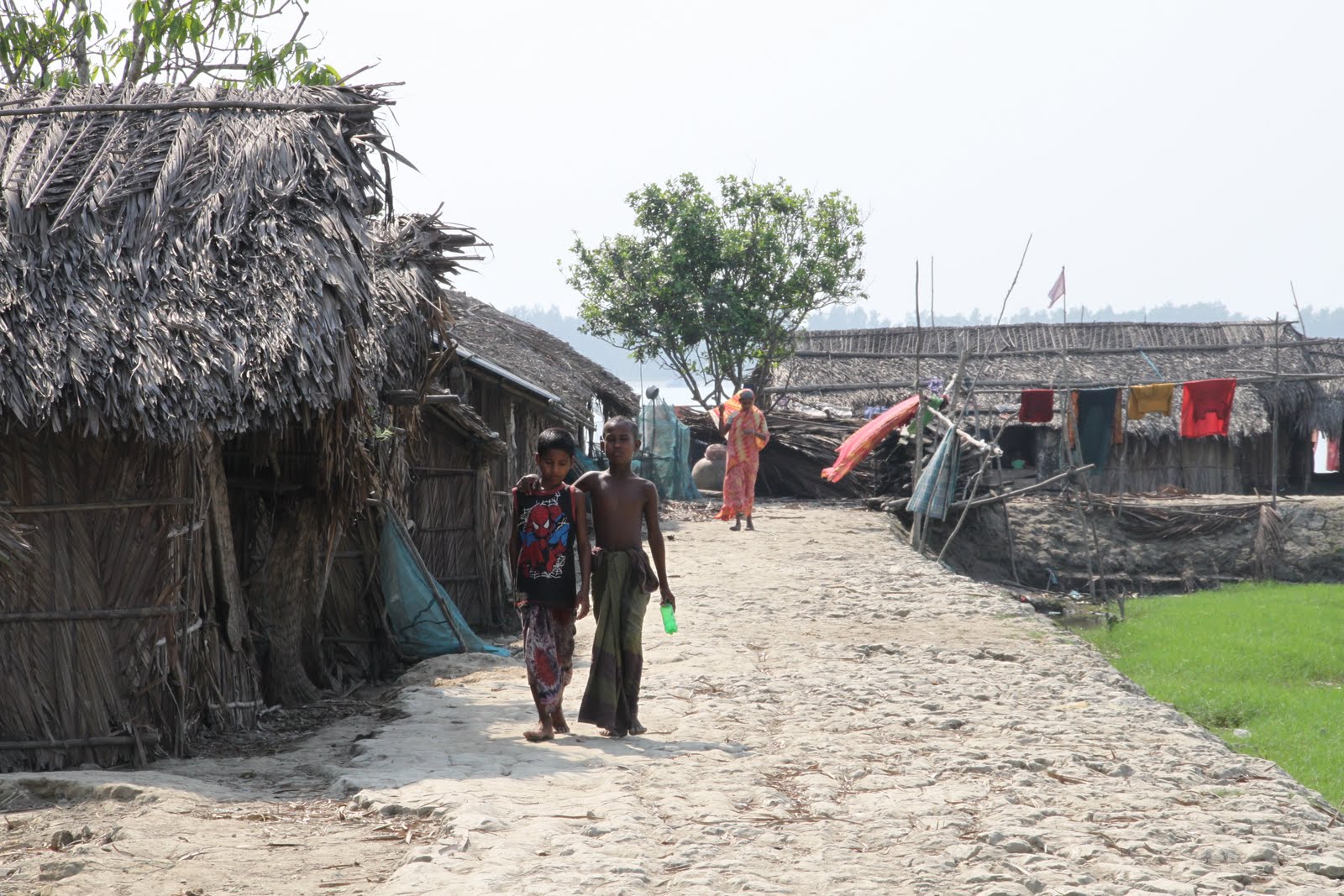
On the return to Mongal Port, we stopped to visit some of the several fishing villages that exist in pockets along the river. Several hundred thousands of people have lived here for generations, primarily living off of the income from selling fish. They’ve suffered a series of disasters that have made life difficult and dangerous. In 2007, the entire area was hit by Cyclone Sidr, resulting in the loss of nearly 10,000 lives. Entire livelihoods were destroyed, provoking agencies like BRAC and Grameen to intervene and provide rehabilitation and development support to these villages. Homes have been rebuilt, and additional livelihood activities such as shrimp harvesting have been promoted to provide additional sources of income for these communities. But, the communities’ daily threat originates from the Royal Bengal tiger, which claims 100 lives annually. In the area we visited, claims were made that nearly every household had lost one member to the man-eater!


Fishermen village in the Sundarbans


Camaraderie in the village


View of fisherman's home from the river

Bangladesh is not yet a tourist attraction, and posters have been erected to promote tourism within the country, stating, “Come visit Bangladesh before the tourists come!” which I found quite amusing. But, I do think I’ll be back, whether it be for work or to explore the eastern coast, containing the tea gardens of Sylhet and the world's longest continuous beach of Cox’s Bazaar.