Thursday, April 8, 2010

Visits to a Divine Abode

Nepal and the mystique surrounding it seem like a far away dream. Now back in Washington, DC, only the photographs seems to verify my memories and some of the most fascinating adventures trekking through the Himalayas. When I realized that my time in Nepal would be cut short with the start of a new job, I was devastated that my trekking trip through Tibet, kora (pilgrim circumambulation) around Mount Kailash, and Everest base camp excursion would all have to be put on hold until another point in my life when I’d have that much personal freedom and leisure time. I hastily put together a list of the key sites and activities I had to experience before returning to the dull West. One was to complete at least a three-day trek in the Annapurna region of the Himalayas, and another was to receive a glimmer of the Everest’s dharshan on a Buddha Air flight.


The trek began from Pokhara, the city of the beautiful Phewa Lake, which I write about in “A Little Taste of Heaven.” After an early morning flight from Kathmandu, two sherpas, met me at the airport and we began the journey into the Annapurnas. As we started the journey, the Sherpa serving as a porter ran ahead of us with ease as he carried the weight of our entire supplies and personal belongings for the next three days. While not a long period, so the supplies were limited, it was still a heavy load, and I was in awe of the weight that the sherpas have been accustomed to carrying on their shoulders and backs for generations- as much as 500 kilos! We trekked along the Seti Gandaki river for several kilometers before beginning the high ascent into the more mountainous terrain through remote villages amidst lush greenery and the rhododendrons that adorn the trekking route to Ghandruk.


Flowing waters of the Seti Gandaki


Mules bringing supplies into the remote villages of the Himalayas


Sherpa carrying supplies across one of many bridges through the range


Grazing mule along the river banks


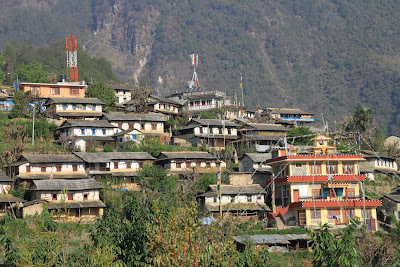
Himalayan village


The views from Landruk and Ghandruk over the course of the three day trek were overwhelmingly breathtaking, and I feel blessed to have been so close to some of the highest, monumental peaks in this world. The Annapurna range is crowned by the Machhapuchhre twin peaks (meaning ‘fishtail’) and studded for miles with other captivating snow-capped peaks overlooking the tribal villages laced with the Nepali prayer flags.


View of Annapurna range from my Landruk guesthouse


A closer view of the Annapurnas


Even closer...you can't get enough of this beauty!


Residents relaxing on their stoops in the evening as we walk on


A Gurung woman sitting outside her hut


The morning before my first field visit to Bihar with the Grameen Foundation, I caught a Buddha Air flight that takes a small number of passengers along the Himalayan range up to the renowned Mount Everest before making a full circle back to Kathmandu. While it by no means compares to seeing Everest from its base camp, one can’t help but feel awestruck by the sight of it, even from the cockpit of the plane. The Himalayas, meaning “abode of snow” in Sanskrit, conjures all sorts of magical images in our minds and continues to profoundly shape the many colorful cultures of South Asia and beyond. It is the mother of several sacred rivers flowing through the Asian continent from Tajikistan to Vietnam and will forever be honored as such in our hearts.


The Himalayas!


Another view of the breathtaking Himalayas


Everest in the distance


Goodbye for now. I will be back.


Friday, April 2, 2010

Microfinance and Enterprise Development in Bangladesh

At a lecture presented at the University of Oxford’s renowned Sheldonian Theater, Grameen Bank’s founder, Professor Muhammad Yunus, stated that “not only is poverty the most pressing issue of our time…it is [also] a problem that we have fully the capacity to tackle and overcome within the first half of the century--- if we choose to do so.” The greater industry of microfinance has evolved from pockets of small-scale programs of limited scope to a diversified and dynamic one that engages several actors in the innovation of more effective methodologies, products, and services to better serve the poor. During my time in Bangladesh, I had the opportunity to visit both Grameen Bank and BRAC’s programs at the field level to gain a better understanding of their approaches in practical terms.

Grameen Bank
Poverty is not a symptom of the poor but rather an outcome of social and economic policies borne out of existing institutions and frameworks. The current banking system is one such financial institution, and as Yunus mentions, is fundamentally flawed when it excludes more than half of the world’s population because they are not deemed credit-worthy. The Grameen Bank was established to develop a banking method which can deliver financial services to those left out of the formal system, particularly women, whom are hardest to reach in most of the world.

I won’t go into the details of the Grameen methodology, structure, and financial products and services here. There are numerous online publications detailing these topics, including the Grameen Bank’s official website. Of Grameen’s 8 million borrowers, 97% are female. Loans are made without guarantees, collateral, or tedious paperwork, however, generally, clients are required to be members of a registered group of 5-10 like-minded individuals who are not blood-related, share a common level of education, are permanent residents of the same village, and are landless*/assetless. Functioning primarily on an honor-based system, Grameen permits a great extent of flexibility on loan repayment schedules without charging penalties, and as of 2008, its repayment rate stood at 98%. An internal survey demonstrates that clients are steadily crossing the poverty line each year with 64% of borrowers, who have been members for at least 5 years, having already crossed the poverty line.

The general structure of Grameen Bank is a hierarchical one, which follows: group → center → branch → area office → zonal office → head office in Dhaka. During my field visit, I visited a center-level meeting for income generation loan clients and the branch office and met with the area office manager in order to get a brief exposure to the most grassroots segments of the structure.

The center level meeting was comprised of approximately 8 groups and was held in a tin structure constructed for the purpose of such weekly meetings. The clients we met were all women, and most were engaged in the business of selling gold scraps stripped from coal to jewelers. During the center meetings, clients engage in loan repayments and weekly savings depositing, followed by requests for new or supplemental loans. During the latter, all members of the applicant’s group must be present and affirm that the purpose and amount of the request is valid. The center head’s opinion and approval is also sought, particularly on the applicant’s ability to repay the amount requested. Within the subsequent week, the branch officer presiding over the meetings conducts her own due diligence of the applicant. The request, if approved, is then proposed to the branch manager, who conducts additional due diligence before approving and sharing with the area manager for approval. Once the application is approved, the branch officer prepares the amount for disbursement, and the applicant is notified at the subsequent center meeting that her loan amount is ready for collection. The repayment schedule, distinguishing principle and interest, is shared with the client at the time of collection to ensure that she is aware of her repayment requirements and options.


Grameen clients gather for the center meeting in Dhumrai


Husbands of the clients contributing to the gold stripping process


Clients deposit their weekly savings and loan repayments during the center meeting

Vehicles could not transport us to the site of the village and the center meeting venue. From the nearest village, we were required to walk a few kilometers before hiring a villager to transport us the remainder of the way on something similar to a rickshaw. We were visiting a center hardly considered remote, presenting just a sliver of the effort Grameen has taken in bringing banking to the poor.


Village children playing with an abandoned fishing boat

BRAC’s Ultra Poor Program
BRAC is the world’s largest NGO, initiated from Bangladesh and now, with offices throughout the world. The agency is also renowned for its work in microfinance and its integration with enterprise development. DABI for poverty alleviation for poor, landless women and Unnoti, providing enterprise development support for marginal farmers, are based on a group lending model, whereas Progoti, which provides enterprise development support for micro and small entrepreneurs, relies on an individual lending model. This integration of microfinance with technical support, provision of high quality inputs, and marketing is called a credit-plus approach and demonstrates a more innovative way of making access to finance an effective tool to bring people out of poverty.

I spent more of my time focusing on the organization’s Ultra Poor Program, which aims to reach the poorest within communities in Bangladesh. Though the program is grant rather than credit-based, it addresses the larger question of how to serve the poorest of the poor. At present, most microfinance programs target those lingering around the poverty line (a little over $2 per day) and assume that those well below the poverty line ($1.25 per day) are not capable of making credit a productive asset to create a diverse set of income generation sources for themselves. This group, with BRAC and other agency support, are proving otherwise.

The income of the ultra poor is even more irregular than that of the poor, and expenditure for matters of survival other than food is zero. Income is generated from begging and most often generated by children of school-going age. After a series of social mapping and grading of solvency, households are selected to participate in the program, through which they receive vocational and other training in income generation activities, assets to engage in the activity, a daily allowance and healthcare to facilitate their success, and ongoing mentoring for up to three years. To complement this, beneficiaries’ communities are mobilized to form poverty alleviation committees to ensure that community members are more intimately involved in the program and are motivated to provide their support to ultra poor members. This understanding nurtures more intimate relationships among the community members and creates a sense of responsibility and achievement as communities, as a whole, are uplifted.

Actors within Bangladesh have made great strides in addressing poverty through innovative means. Their success has spurred inspiration and replication of similar programs throughout the world. When I received a call from Grameen Foundation USA offering me a position with their Solutions for the Poorest unit while I was coincidentally visiting these initiatives, it seemed to be destiny, and I accepted. This month, I will start working with the unit to design and execute pilot programs testing the “downscalability” of integrated and value chain approaches of microfinance and enterprise development. We will start in India, and when successful, will expand this mission on a global scale. A choice has been made, and the journey finally begins.

*landless = less than 50 decimals of land


Saturday, March 27, 2010

Bangladesh in Two Weeks: Dhaka → Jessore → Khulna → Bagerhat → Mongal Port → Sundarbans → Dhaka → Dhumrai

Earlier this month, I traveled to Bangladesh with the primary intent of visiting two of the microfinance field’s premier institutions, the 2006 Nobel peace prize winner, Grameen Bank, and BRAC in order to gain insight into a different set of microfinance/microenterprise development models developed to address the larger issue of poverty. The trip also served as an ideal opportunity to explore another part of South Asia, unique in its blend of cultural, religious, and linguistic character.

Dhaka is the city of rickshaws (400,000 run each day), which may possibly be the primary mode of transportation for its 16 million inhabitants by day and 13 million inhabitants by night. The sites of Dhaka are diverse in architecture, mirroring its history as part of several Indian Hindu dynasties, Buddhist kingdoms, the Mughal empire, British Raj, and East Pakistan before evolving into the modern capital city of the 1971-established Bangladesh.


Rickshaw drivers awaiting business outside the Pink Palace

The city is situated along the Buriganga river, and its Sadarghat serves as a lively economic center, where merchants and clients engage in the buying and selling of a variety of goods.


Boatmen of the Buriganga River


Trading at Sadarghat


The lone boatman

Religious shrines and monuments are in abundance, and Dhaka is believed to have been named after the Dakeshwari Hindu temple, honoring one of the many forms of the goddess, Kali. Azaan can be heard five times a day, and the melody and vibrations never cease to stir my soul, evoking an overwhelmingly surreal divine sensation tugging within the depths of my core. The Star Mosque (Tara Masjid) is one of the most ornate mosques of the city, studded with blue star motifs and colorful shards of Chinese porcelain. After visiting this piece of history, we moved on to the Lalbagh Fort, which is an incomplete Mughal palace fortress that was abandoned after the death of the daughter of the Mughal leader at the time, Shaista Khan.


View of the Lalbagh Fort upon entering


Dormant at the Fort


The Tara Masjid


Ornate decor of the Tara Masjid


Preparing for Jumma (Friday) prayer

Bangladesh is home to three UNESCO world heritage sites, of which I visited two. Bagerhat, a historic mosque city, is located in Khulna division in the southwest corner of the country. There are over 50 mosques and mausoleums that were constructed under the Mughal ruler, Ulug Khan Jahan, mostly made of red brick, blending Mughal with more modern architectural styles. The most significant of these is the Shat Gombuj Masjid, containing more than 60 pillars and 81 domes.


View of the Shat Gombuj Masjid from the Bagerhat museum


The Shat Gombuj Masjid


A few of the Shat Gombuj's 60 pillars


The three-domed mosque of Bagerhat


Pilgrims at the shrine of Khan Jahan

Perhaps 200 kilometers away from Bagerhat is the second world heritage site, the Sundarbans, the “single largest block of tidal halophytic mangrove forest in the world” and home to the notorious man-eater, the Royal Bengal tiger. The forest covers 10,000 square kilometers, of which 6,000 are in Bangladesh and 4,000 fall within India. In order to reach the forest, we hired a small engine boat from Mongal Port and rode down the river for nearly 2 hours before reaching the Karamjal Wildlife breeding center, where I’ve never seen so many alligators cooped up in a single space. Deer and monkeys are also bred here to ensure that the forest’s wildlife remains replenished. Once we reached our second stop, the hiking began through the forest with an armed escort in the case that we were to chance upon one of the man-eaters. Unfortunately, the most exciting sighting was its month old paw prints amidst the lingam-like roots of the mangrove trees.


The Sundarbans mangrove forest


The lingam-like roots of the mangroves


Paw prints of the notorious man-eater

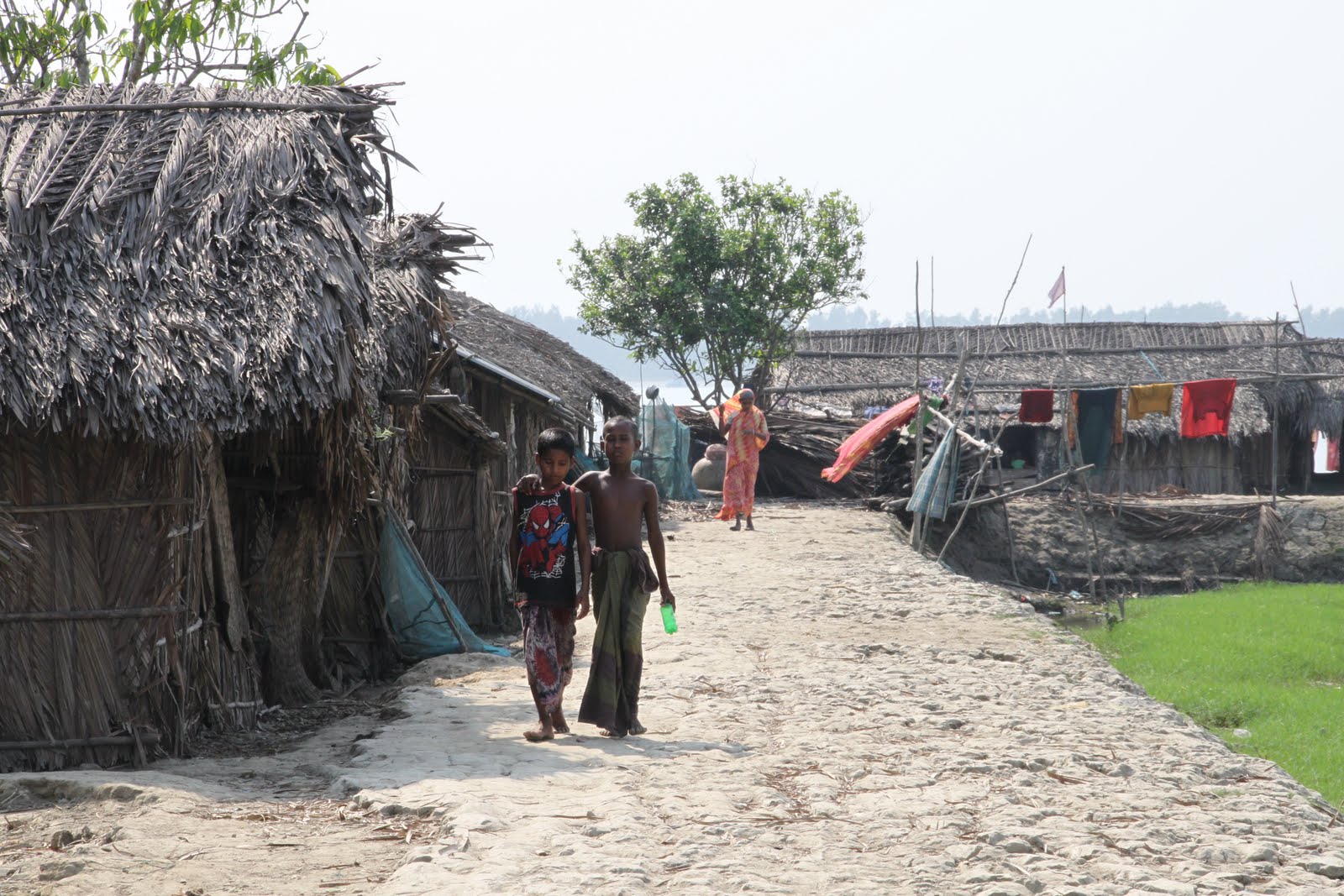
On the return to Mongal Port, we stopped to visit some of the several fishing villages that exist in pockets along the river. Several hundred thousands of people have lived here for generations, primarily living off of the income from selling fish. They’ve suffered a series of disasters that have made life difficult and dangerous. In 2007, the entire area was hit by Cyclone Sidr, resulting in the loss of nearly 10,000 lives. Entire livelihoods were destroyed, provoking agencies like BRAC and Grameen to intervene and provide rehabilitation and development support to these villages. Homes have been rebuilt, and additional livelihood activities such as shrimp harvesting have been promoted to provide additional sources of income for these communities. But, the communities’ daily threat originates from the Royal Bengal tiger, which claims 100 lives annually. In the area we visited, claims were made that nearly every household had lost one member to the man-eater!


Fishermen village in the Sundarbans


Camaraderie in the village


View of fisherman's home from the river

Bangladesh is not yet a tourist attraction, and posters have been erected to promote tourism within the country, stating, “Come visit Bangladesh before the tourists come!” which I found quite amusing. But, I do think I’ll be back, whether it be for work or to explore the eastern coast, containing the tea gardens of Sylhet and the world's longest continuous beach of Cox’s Bazaar.


Friday, February 26, 2010

Motorcycle Diaries

Earlier this month, I concluded two months of field visits across Nawalparasi and Kapilvastu districts, conducting fifty client and three savings and credit cooperative interviews. While a car, busses, and our own feet were frequent modes of transportation, most of the visits were done on motorcycle. If it had been spring, it would have been marvelous, but, at the peak of winter in Nepal, all I can say is, never again.

Interviews were conducted in some of the most unusual settings, which were often the places of work and/or habitation for the clients. They varied from roadside fires to restaurant-cum-single room homes of thatched straw, where animals for the menu’s meat dishes scuttled around freely until placement of the next order. I struggled to hide my alarm when a chicken was grabbed by its feet from under my seat, bokking cacophonously, during an interview. In another instance, I couldn’t help disrupting the entire interview when the mother of all geckos, the size of an infant alligator, appeared from behind a client’s couch as it made its way up the wall at a snail’s pace. I suppose some things just take getting used to!


Interview with client in her restaurant, started up with a Binai loan


Conducting interviews with Binai SCC clients outside of the office in Dhumkibas VDC


Tea or chai holds a very dear place in the heart and palate of Nepalese, as it does for most Asians. From Sri Lanka to Afghanistan, chai plays a vital cultural and social role and is the first offering made to guests, customers, and clients alike before commencement of a meal or meeting. Consistent with this, many of our clients, some of the poorest in their communities, served us chai mixed with milk and sugar, during the interviews. Though I had to be conscious of what I was putting into my body, considering that most of the water consumed by these communities would not be considered potable by UN standards, I still forced myself to take a few sips in order to welcome their hospitality and shed a little bit of the unspoken barriers between me and them.

In all honesty, 60-90 minute interviews are not nearly sufficient to get a true sense of both the financial and social conditions of individuals living in rural communities, and this is for several reasons. Trust is one of the most obvious barriers to overcome, and this can only be built with time and regular interaction with the clients in order for them to share the irregular or intimate details of their lives. For example, when assessing how savings and credit and cooperative membership has empowered women in communities where women have traditionally been viewed and treated as subordinates to their male counterparts, only rarely have they felt comfortable enough to share their stories of abuse, both verbal and physical, and any transformation that has occurred as a result of becoming financial contributors to their households. In this same context, the defining of concepts and methods of perception are a second type of barrier. How does one assess whether these services have served as a catalyst for social empowerment? In such instances, language and tact serve as critical tools. When discussing these issues with Dalit (“untouchable”) and female clients, we often try to assess changes in ‘empowerment’ and ‘leadership’ by gauging clients’ participation in community activities, community and household level decision-making, and perceptions of respect from the community, the family, and the self. While completion of the questionnaire is a requirement in the data collection process, the most invaluable information flows from the stories and reminiscence of the clients as they ponder over the most significant transformations that have taken place in their lives.

The third most noteworthy challenge has been the level of financial literacy of the clients. Household (HH) income is an aggregate figure that takes into account the multiple sources of income generated by rural, poor, and/or disadvantaged HHs. Individual income from daily wage labor or a regular salaried job has solely comprised HH income only in a minority of cases. Most clients in Nawalparasi and Kapilvastu districts cultivate land for agricultural production that is consumed by the HH and/or sold in the market. Similarly, most clients, regardless of their microenterprise, generate an income from livestock production and its byproducts (e.g., meat, milk, ghee, etc.). Collecting this information individually involved clients having to conceptualize income in the same manner as the interviewer, which proved to be a painstaking exercise. When it came to questions on savings, most interviewees didn’t know how to respond when asked how much money was put aside as savings and where these monies were kept. Some may have been kept in a savings and credit cooperative, but what about the small notes sown into a mattress or tied inside the pallu of a sari? Again, language and tact played a crucial role in collecting this information, and I am grateful for having a translator accompany me on these interviews.

At the conclusion of the last day of field interviews, the team made its way back to Gaindakot, this time in a crowded public bus that had exceeded its capacity in both weight and density. After being upgraded from standing amidst an uncountable number of individuals, strange heads resting on my shoulders, to an aisle seat full of confrontations with wailing babies and elbows, it gave me an unexpected opportunity to reflect on all that I have seen and experienced in these last few months. What I have been exposed to is not the exception but a reality for most of the world’s population, and I don’t think I ever fully grasped this until I was actually thrown into its tumult.

It’s been an unforgettable ride, and the experiences derived from it all comprise my life in Nepal these last four months, my motorcycle diaries.


Tuesday, February 16, 2010

Life and Times in the Village

After some time, what were once perceived as extraordinary feats, gradually become the mundane functions that keep the wheels of life well oiled in the village. Initially when I moved to Gaindakot, my half-hearted attempts to acclimate to a simpler lifestyle were met with my own resistance to the required input of ever more time and effort to implement the most minor of tasks. Life in the United States can be characterized by what John Perkins, in Confessions of an Economic Hitman, refers to as the corporatocracy, which traps citizens in the clutches of capitalism, where the culture of mass consumerism-I want the fastest, the latest, and the best- prevails. We are all victims of it, and in our self-indulgence, we often forget that most of the rest of the world knows not such a life. What we define as basic necessities are defined as exclusive luxuries for the majority of the world’s population. When friends and family press for details on what life has been like living in semi-rural Nepal, my response is that it must be like what Jaffna must have been before the occupation, but just without the beach.

Each morning and evening, the mother fetches fresh buffalo milk from a neighbor for our chai. If the buffalo becomes pregnant (as was the case this past week), then another neighbor is approached to sell some of her buffalo’s milk. A boiled cup of this milk always follows each of the two meals of the day, which consists of rice and dhal (dhalbaat), a vegetable dish, and pickle, typically spiced with sesame seeds, turmeric, ginger, garlic, fenugreek, cumin, and cilantro. Nearly all of the inputs for the meals come from the kitchen garden behind the house, situated alongside the storehouse for wheat and rice. Rather than buy flour and cooking oil directly from the market, my host family prefers to routinely have their wheat freshly ground into flour by the local miller and oil pressed from mustard seeds grown in a field adjacent to the house. It’s an organic food lover’s paradise. Morning and evening meals are freshly prepared before each mealtime and served on metal or brass plates. When rinsing off the paste from our hands after meals, the saturated water is collected and dumped in a bucket that is fed to the buffalos with their rice grass. There is a system for nearly everything!

Laundry is most often hand-washed and hang dried anywhere that two ends of a cord can be tied. I usually give my laundry to the training institute’s laundryman because I don’t have the time, patience, or energy to pick up some new habits. Once washed, I hang the clothes on my roof to dry along with the undergarments that I wash at home. After literally buffing off layers of skin, I’m starting to get the hang of hand washing!

Like in Afghanistan, the working week is comprised of six days, while Saturdays are set aside for the weekend. After work, we usually sit on the balcony with a cup of tea, watching the neighbors’ children play cricket, badminton, and other small games, or I sit on as a casual observer as my host family engages in random chitchat with their neighbors. In the winter, since there is no heating system, we usually warm our frozen bodies around fires that are lit next to the field and fed with rubbish and dry leaves. Unfortunately, there is no solid waste management offered to residents outside of Kathmandu, so to take out the garbage, literally means to dump the contents of your bin in an assigned location near the field and set it alight. The two times a month that I do this, I’m wrought with guilt for partaking in this environmentally totally unfriendly practice.

The inconvenience most strongly felt is from the load shedding. Nepal is the world’s second richest country in water resources, yet, it is unable to generate enough electricity for its population, particularly during the months leading up to the monsoon. These days, we are forced to schedule things around a 12-hour daily load shedding schedule, and I hear that this will likely go up to 18 hours per day over the next few months. Lack of appropriate infrastructure aside, games that allow this condition to fester are played on many sides. Candle and generator salesmen make a handsome profit during these months, so what’s to stop them from giving the local electricity controller an “incentive” to prolong load shedding a little bit here and there. With rare access to power, productivity of businesses and other service providers is hit the hardest.

The second worst inconvenience is the effect of Nepal bandh on nearly everything. When bandh is called, as I discussed in a recent entry, businesses are required to stay closed, and motored vehicles are not permitted on the roads. Every time I book a flight out of Nepal, I’m sure to travel to Kathmandu a few days earlier in case an unanticipated bandh is announced and reluctantly prepare myself mentally for having to walk to the airport if a rickshaw doesn’t present itself in time.

I’ve, more or less, come to terms with this lifestyle, more so because I know in my mind that this is temporary. I value it because it is an experience in itself, but the perspectives that I’m gaining personally will hopefully help me to do my job a little bit better over the long run. What never ceases to amaze me is the peace of mind displayed by these communities. Maybe, simple is better after all.


View of Gaindakot village from my balcony

Saturday, February 6, 2010

The Year of the Tiger

After two months of field visits in rural Nepal, I welcomed the idea of a brief R&R in Singapore when friends of mine suggested that a visit was in order, given my close proximity to the country. My last visit to the city-state was in 2004, and I was astounded by the many newly constructed shopping malls and skyscrapers that studded Singapore’s skyline, not to mention a little overwhelmed by the 180 degree turn in atmosphere and culture.


Sarangoon Road, home to Little India, was lodged in my memory as a somewhat chaotic bubble of cyclists, pedestrians, and cars, swarming around stalls and shops selling a variety of fruits and vegetables, spices, Indian jewelry and fabrics, and just about anything else one could want from the neighboring subcontinent. I remember holding onto my Amma’s hand tightly, as a kid, as we queued for an open table at Muthu’s Curry Place to enjoy mouthwatering fish curry and rice eaten straight from a banana leaf as is still done in northern Sri Lanka and southern India. I was surprised to find more order in this city within a city this time around, though admittedly, I began to miss the raucous of its old character, reminiscent of walking through the streets of Coimbatore and then-called Madras.

Chinatown was an absolute rush of color and aromas as we walked through its streets, as residents and shopkeepers prepared for the Chinese New Year festivities to be held in the subsequent week. We witnessed a prayer ceremony in a Buddhist temple, its walls studded with 100 golden Buddhas on the main floor and 10,000 miniatures on the roof, housing a tooth relic of Buddha and one of the largest prayer wheels in Asia. Blooming cherry blossoms lined Chinatown’s sidewalks, and temporary tents had been erected to house markets selling the colorful red decorations hung in every Chinese home, this year sporting figures of the tiger, the zodiac animal marking 2010. We treated our palettes to coffee-flavored, chocolate biscuits, flower-shaped cakes, the Chinese version of ice cream sandwiches, and coconut-infused gelatin sweets, washing it all down with fresh mango juice and lemon soda.


Singapore has somehow become a magnet for many friends, relatives, and colleagues of mine, mostly due to its high standard of modern living with access to rich cultures and flavors within and in close proximity to the country, providing a convenient balance of east and west. And, that’s a good enough reason for another visit to this tropical city-state.